Product Overview
The telescopic boom is the structure that does the lifting on a truck crane, and it is the one part of the machine that cannot be improvised. This crane boom assembly is built for the QY25K-II 25 t carrier: the boom mounting, pin centres, section profile and telescoping cylinder layout follow that machine, so a damaged boom can be replaced without modifying the turntable or the hydraulic circuit. It is one of the few mobile crane spare parts where the machine serial, rather than the part description, decides what ships.
Fleets order a boom after an accident, after a section has cracked at a lug or a pin boss, or when an older unit fails inspection and needs a new structure to stay in service. Because the structure and its boom telescoping system belong to a specific build, the machine decides the part and not the other way round. The same discipline runs through the rest of our construction machinery spare parts: the number on the machine is confirmed before anything is packed.
XCMG has been building construction machinery since 1943, and the QY series is one of its long-established truck crane families. The carrier data, lifting data and working speeds further down are the manufacturer's figures for this model, so a workshop can plan the lift, the transport and the site access before the boom arrives.
We supply xcmg crane parts and boom structures from stock in Shenyang, alongside the hydraulic, electrical, undercarriage and cab items that keep the rest of the fleet working, so a single repair does not become five separate purchases.
Boom Construction & Telescoping System
- Patented telescoping system. The boom telescoping system is XCMG's own design, covered by a Chinese patent. Its sequencing limits the load that can be forced into the telescoping cylinder when the boom is operated out of order, which is where bent cylinder rods, distorted sections and cracked booms usually begin.
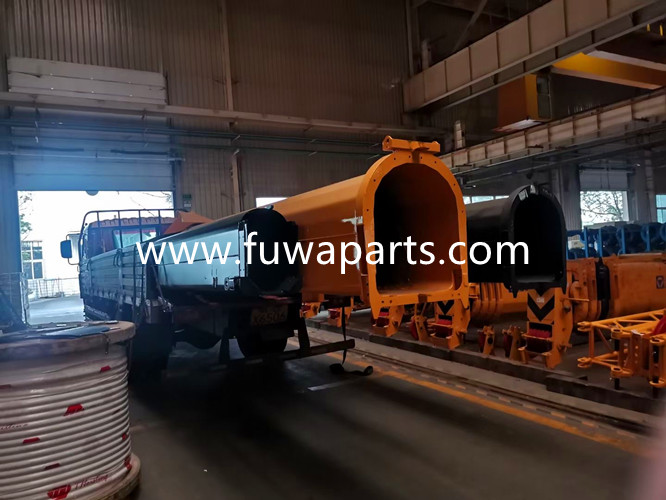
- Section form. The truck crane boom is built from long telescoping sections with a tapered profile, mounting lugs on the outer faces and end fittings drilled for pins. The open ends and lug positions locate each section on the machine, so they are checked against the drawing before dispatch.
- Telescoping cylinder. The black cylinder that drives extension sits inside the section stack. It is one of the crane hydraulic parts that suffers most from contaminated oil and from extending under load, so we quote it together with the boom when the old unit is scored, pitted or leaking.
- Wear pads and sliding surfaces. Each section runs on pads that set the clearance between sections. Worn pads let the boom drop and put the load onto the cylinder, so pad condition is checked before a new boom is fitted and pads are added to the order when they are needed.
- Pins, bores and lugs. The boom attaches through pin joints at the foot and at the lugs along the section. Bore size, pin diameter and lug spacing are matched to the machine; if a lug has been repaired in the field, send a photograph of the repair so the new part is not built to the wrong dimension.
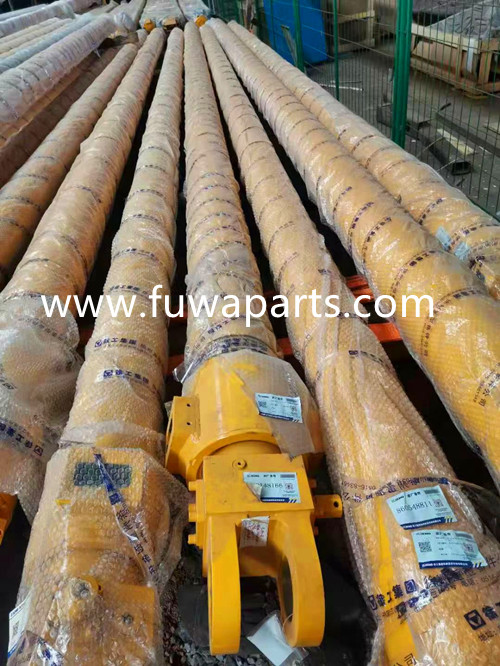
- Welds and paint. Structural welds at the lugs, bosses and end fittings are inspected before painting. The finished boom is painted yellow in the XCMG colour scheme, and the long sections leave wrapped in protective plastic to keep grit and moisture off the machined faces in transit.
- What arrives with the assembly. A complete crane boom assembly is delivered with its section stack and telescoping cylinder; pins, pads and rope are confirmed separately on the order. Ask for the packing list before dispatch so the workshop knows what will be reused from the old boom.
- Matching crane spare parts. A boom replacement rarely happens alone. Sheaves, wire rope, the hook block, limiters and the seals around the cylinder are ordered with it, and we quote them together so everything reaches the site in one shipment.
Specifications
| Specification | Value |
|---|
| Overall length | 12,650 mm |
| Overall width | 2,500 mm |
| Overall height | 3,380 mm |
| Total weight in travel | 29,400 kg |
| Front axle load | 6,200 kg |
| Rear axle load | 23,200 kg |
| Max. travel speed | 75 km/h |
| Min. turning diameter | 21.5 m |
| Min. ground clearance | 275 mm |
| Approach angle | 16° |
| Departure angle | 13° |
| Max. grade ability | 30% |
| Fuel consumption per 100 km | approx. 37 L |
Engine & Power
The QY25K-II carrier has been built with two engine options: the SC8DK280Q3 and the WD615.329, the second in domestic III specification. Their ratings differ slightly — 206 kW at 2200 r/min against 213 kW at 2200 r/min — and so does torque, 1112 N.m at 1400 r/min against 1160 N.m at 1400 r/min.
Read those figures the way a workshop does: power at 2200 r/min is what the engine gives near the top of its range, while the torque peak at 1400 r/min is what pulls the carrier and its truck crane boom along the road and holds speed on a climb. The domestic III version is the later emission build, and the engine plate on the machine is the only reliable way to tell which one you have.
Engine choice does not change the boom structure itself, but it does change the surrounding xcmg spare parts on the order: filters, belts, sensors and the wiring that runs to the carrier. Give us the engine number together with the machine serial and both sides of the enquiry are matched in one step.
If the engine plate is missing or painted over, send a photograph of the injection pump and the block area. Engine identity is usually recoverable from those two images, and it saves a second round of questions before the boom order is confirmed.
Lifting Performance & Working Speeds
| Working data | Value |
| Max. rated total lifting capacity | 25 t |
| Min. rated working radius | 3,000 mm |
| Max. lifting torque | 1,010 kN.m |
| Turning radius at turntable tail | 3.065 m |
| Base boom | 10.7 m |
| Fully extended boom | 34.19 m |
| Fully extended boom + jib | 42.15 m |
| Longitudinal outrigger span | 5.14 m |
| Lateral outrigger span | 6 m |
| Boom luffing time | 75 s |
| Boom full extension time | 100 s |
| Max. swing speed | ≥2.5 r/min |
| Max. speed of main winch (single rope) | ≥120 m/min |
| Max. speed of auxiliary winch (single rope) | ≥120 m/min |
Boom, Jib & Luffing Jib Range
- Telescopic boom. The road-travel truck crane boom: sections extend hydraulically to working length and retract for transport. This is the assembly used on the 25 t carrier here and the type most fleets need after damage. It is supplied within our xcmg crane parts range, matched to the machine rather than to a description.
- Fixed jib boom. A jib that bolts to the boom head at a fixed offset to add reach beyond the fully extended boom. It suits lifts where a little more height or radius is needed and the load stays light enough for the jib rating. Tell us the head fitting on your boom so the jib matches.
- Luffing tower boom. For tower configuration work, where the boom is luffed to a steep angle and the machine works at height rather than at long radius. These are prepared to order against the machine and the job, so drawings and photographs of the head and foot connections are needed first.
- Which one fits the job. Road travel and general lifting point to the telescopic boom; extra reach at light load supports a fixed jib; work at height under a tower arrangement supports a luffing boom. If the machine already carries a jib, we can supply the boom and jib as a pair.
- Electrical protection on the boom. Length and angle limiters, proximity switches and the cab monitors that read them are crane electrical parts that stop the boom before it reaches a mechanical limit. Replace them with the boom rather than after it, because a limiter that has been bypassed is often why the old boom failed.
- One source for the crane boom assembly and the fittings. As a crane parts supplier we quote the boom together with the sheaves, rope, pins, pads and seals that fit it, and we can draw on the same stock for the crawler, hydraulic and cab items on the rest of the fleet.
- Parts around the boom. Pins, bushes, shims, seals and the cylinder rebuild kit for the boom telescoping system are xcmg spare parts that are easy to overlook when a boom is ordered. Ask for them at the quotation stage and they travel with the structure instead of following it weeks later.
- Jib storage. Most fleets run the telescopic boom permanently and carry the jib only when a job needs it. Storing the jib on stands, with the pin holes greased and the fittings covered, keeps it usable when it is called for.
Ordering & Delivery
- Send the machine model, the serial number and photographs of the nameplate and the damaged boom section with your enquiry. If a number is stamped on the old section, photograph it as well. This is how every construction machinery spare parts order starts with us, and it saves a round of questions.
- Tell us what you need with the boom: complete assembly, individual section, telescoping cylinder, pins, pads or a jib. The crane hydraulic parts that come with the assembly are confirmed item by item before quoting, because a boom ordered without its cylinder becomes a second shipment.
- We confirm availability and price. Most parts are in stock; the usual lead time is 7–20 days depending on quantity, and orders start from 1 piece, so a single pin and a single boom are handled the same way. Our xcmg spare parts stock is checked against your serial at this stage.
- Payment is by T/T, Western Union or as agreed.
- Shipping is arranged on EXW, FOB, CFR or CIF terms, shipped via Shanghai, Dalian or another Chinese port to suit the route.
- Every boom is given a final inspection before dispatch and packed with the long sections wrapped and braced. Long mobile crane spare parts need that bracing to survive sea freight, so ask for photographs of the packed boom if you need them for your own receiving check.
- Warranty is 2,500 working hours or one year.
- For crane spare parts ordered alongside the boom, ask for one consolidated shipment. Sheaves, rope, seals and cab items can travel together when they are on the same order.
- As a crane parts supplier we have handled XCMG structure parts through ten years of export trade. If your workshop wants the boom, the fittings and the hydraulic items on one packing list, say so at the quotation stage and we build the order that way.
- Limiters, sensors and cab monitors travel with the boom as crane electrical parts. If the old units were damaged in the same incident, add them to the same order rather than sourcing them locally afterwards.
Boom Fitment & Lug Matching
- This boom is built to the QY25K-II carrier, not to a lifting capacity. The mounting ears on the turntable, the foot pin diameter, the boom luffing cylinder pins and the telescoping cylinder stroke all belong to that machine, and those are what we check against your serial before anything is quoted.
- A second crane rated at 25 t is not automatically a match. Mounting ear spacing, pin diameters, the position of the luffing cylinder lug and the section profile change between model lines and between production years of the same line, so the tonnage on the plate tells you very little about whether a boom will sit correctly.
- The load chart belongs to the machine the boom was designed for. If a structure from another build is fitted, the chart in the cab no longer describes the crane, which is a problem at inspection and a larger one on site. That is why we do not supply a boom on the strength of the tonnage alone.
- A repaired lug has to be measured, not assumed. Field welding, build-up and re-boring can leave a bore oversize, off-centre or out of line with the opposite lug; a boom built to the original drawing will then either fail to pin up or load the pin unevenly. Send the bore diameter, the gap between the two lugs, the plate thickness and square-on photographs of both sides of the repair.
- If the repair was made on site and no drawing exists, measure the boom you have rather than the one in the manual. Pin bore, lug spacing, section height and the distance from the foot pin to the first lug are enough for us to compare your structure with the original and tell you whether it can be matched.
- Where the damage is limited to one section or one lug, a replacement section built to the original drawing is often a better answer than a complete assembly. It keeps your existing telescoping cylinder, pads and pins, costs less to freight, and preserves the numbers already recorded for the machine.
- Send the machine serial, a photograph of the nameplate, the number stamped on the old section if there is one, and the measurements above. Those four things let us confirm the fitment in writing, and they also let us flag the crane hydraulic parts around the boom — cylinder, seals, pipework — that may need to travel with it.
- Booms from SANY, ZOOMLION and FUWA machines use their own fixings and do not cross over, even where the lifting capacity is the same, so those are quoted as separate fitments. On any crane spare parts or mobile crane spare parts order we handle, the machine decides the part, and nothing is cut, painted or packed until the fitment is agreed against your own measurements.
Technical Support & Model Matching
Not sure which part fits your machine? Send the part number, the machine model, and a photo of the nameplate or the worn item, and our engineers — each with more than ten years in the construction machinery business — will confirm the correct reference and quote it. We advise on installation, help trace faults, and answer technical questions before and after dispatch. Since 2017 we have built this support on a supplier network covering FUWA, SANY, XCMG and ZOOMLION, so older and hard-to-find references can usually still be sourced.
FAQ
Q1. Which crane does this boom fit?
It is built for the 25 t truck crane in this model line and follows that machine's mounting points, pin centres and telescoping cylinder layout. As a crane parts supplier we confirm the build from the serial before quoting, because XCMG changed details across production years and two machines sold under the same model name can carry different boom fixings.
Q2. I only know the crane model and have no part number. What can I send?
Send the machine model and serial, photographs of the old boom, the nameplate and any number stamped on the section. Measurements across the pin holes, the distance between lugs and the section profile also help. With those we can trace the assembly in our xcmg crane parts stock and tell you what can be supplied.
Q3. How does the telescoping system reduce the risk of bending the cylinder?
The telescoping sequence is controlled so the cylinder cannot be forced to extend a section against a locked or wrongly pinned boom. That is the situation where rods bend and sections crack. The design is XCMG's, protected by a Chinese patent, and it is one reason a genuine structure is safer than a copied one that only copies the outside shape.
Q4. Is the boom supplied complete or as sections only?
Both routes exist: a complete assembly with its telescoping cylinder, or individual sections where the rest of the boom is sound. The decision comes from the photographs and the serial, and we tell you which parts of the existing boom can be reused before anything is ordered.
Q5. Will this boom fit another 25 t crane?
No. Boom mounting, pin diameters and cylinder stroke are machine-specific, and a boom that bolts up but does not match the machine's load chart is dangerous. Confirm against the serial and the plate rather than against the lifting capacity alone.
Q6. What finish does the boom come in?
It is painted yellow in the XCMG colour scheme, with a matte finish, and the long sections are wrapped in protective plastic. Paint batches vary over the years, so if the machine has to match a fleet livery, send a painted panel or a colour reference and we will confirm the closest match before the boom is painted.
Q7. What maintenance keeps a boom working after installation?
Keep the sliding surfaces lubricated to the machine's schedule, watch pad wear, keep the cylinder rod clean and check pins and bores for play at every service. A boom that starts to drop or extend unevenly is usually showing pad or cylinder wear rather than a structural fault, and catching it early avoids a second replacement.
Q8. Do you supply the hydraulic parts that go with the boom?
Yes. Telescoping cylinders, cylinder seals, valves and the pipework around them are the crane hydraulic parts most often ordered with a boom, and we quote them against the same machine serial so the fittings match. A cylinder rebuilt or replaced at the same time as the structure avoids a second strip-down.
Q9. How is a boom this long packed for shipping?
The sections are wrapped, braced and loaded so machined faces, pin holes and the cylinder are protected. The exact method depends on whether the boom travels in a container or as breakbulk, which is why long mobile crane spare parts are planned with the receiving port in mind. Tell us where it is going and we confirm the packing for that route.
Q10. What else can you supply for cranes?
Alongside the boom we carry structure parts such as lattice booms, jibs, counterweights, hook blocks and sheaves; crawler parts including track shoes, upper and lower rollers, idlers and sprockets; hydraulic pumps, motors and valves; electrical monitors, controllers, cables, switches and sensors; and maintenance items such as filters, seal kits, repair kits and wire rope. Larger crane spare parts orders are usually combined into one shipment.
Q11. Do you cover other Chinese crane brands as well?
Yes. Our construction machinery spare parts stock extends to SANY, ZOOMLION and FUWA as well as XCMG, which matters when a fleet runs mixed brands and a single workshop handles all of them. Send the model and number for each machine and we confirm what is available together.
Q12. How is the boom checked before it is shipped?
A pre-production sample is agreed before the batch is prepared, and every boom gets a final inspection before shipment: dimensions against the confirmed drawing, weld condition, pin bores, cylinder fit and paint. Anything that does not match the confirmed specification is corrected before packing.
Q13. Do you supply the limiters and sensors that protect the boom?
Yes. Length limiters, angle sensors, proximity switches and the cab monitors that display them are part of our crane electrical parts range. Give us the machine serial and the position of the failed unit, and we match the replacement so it plugs into the existing wiring loom rather than needing rewiring.