Product Overview
Proximity sensors are the non-contact switches that tell a crawler crane's controller where a moving part has reached. These two are the replacements for the QUY80 proximity sensor, and the same bodies fit the QUY150 and QUY650: an M30 barrel and an M18 barrel, both threaded so they screw into the bracket already on the machine, both embeddable so they can sit flush in steel, and both switching a PNP output when a metal target comes within range of the face.
We keep them because an inductive proximity sensor is one of the crane electrical parts on a QUY that fails without any warning at all. There is no noise, no leak and nothing to see; the function it guards simply stops repeating, or the controller reports a fault that clears on the next start. The machine looks healthy and behaves badly, which is why the sensor is usually the last thing checked and the first thing replaced.
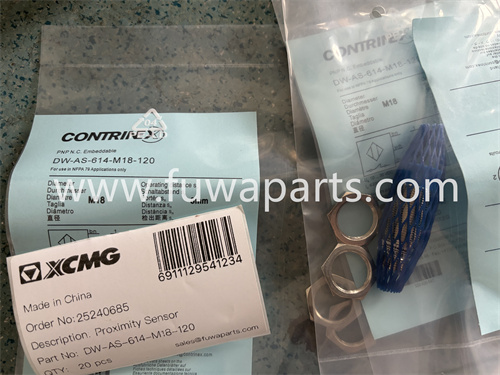
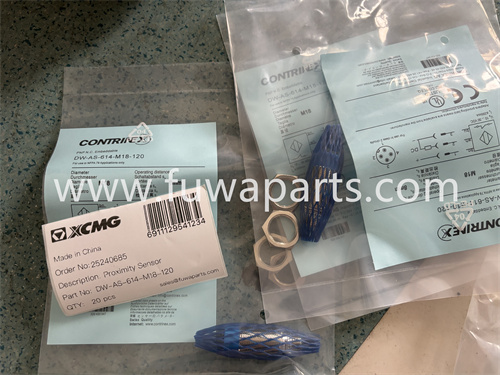
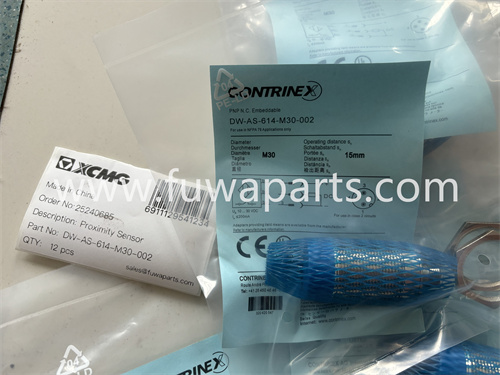
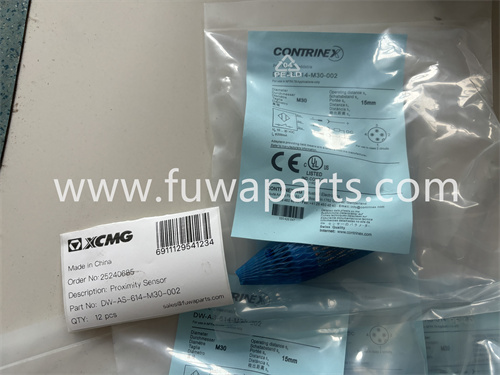
Each unit arrives in a sealed bag with its printed label and its mounting nuts. The label carries the part number, the body diameter and the output type, and that label is what you should read before ordering — the two body sizes are not interchangeable, and the number on the old sensor is the only reliable way to get the right one first time from any crane parts supplier.
Sensor Body & Output Options
| Attribute | Detail |
| Sensor type | Inductive proximity sensor, non-contact |
| Body form | Cylindrical with a threaded barrel |
| Body sizes | M30 proximity sensor (30 mm barrel) and M18 (18 mm barrel) |
| Mounting style | Embeddable (shielded), for flush mounting in metal |
| Output | PNP, supplied in normally open and normally closed versions |
| Target | Metal |
| Supplied with | Printed label and mounting nuts in a sealed bag |
| Fits | XCMG QUY series crawler cranes: QUY80, QUY150 and QUY650 |
Fitment Across the QUY Series
- QUY80, QUY150 and QUY650: both body sizes are supplied for this crawler crane family, so whether you are ordering the QUY80 proximity sensor or one for a QUY650, the same barrel size appears in more than one position on the machine.
- Start from the position: photograph the failed unit in its bracket and note what it is sensing before you take it out. Position is often the quickest way to describe a fault to us, and it tells you whether the bracket or the target has moved.
- Then match the number: the label on the barrel gives the deciding reference. If the label has worn away, measure the barrel and check the bracket opening — that narrows it to one body size.
- Other models: if your machine is not one of these three, send the model, serial number and a photo of the old unit. Where the number is not one we list, we will trace the right XCMG crane parts reference for you.
- Check the rest of the circuit while the sensor is out. A clean thread in the bracket, an undamaged cable and a sound plug are the crane electrical parts that matter as much as the sensor itself, and a crushed cable will make a new unit behave exactly like the old one.
- Buying ahead: these are small, light mobile crane spare parts, and a second failure usually arrives at the worst possible moment. If you run several QUY cranes, holding one M30 proximity sensor and one M18 body in the store is worth the shelf space.
Diagnosing a Failed Sensor
A proximity sensor on an XCMG QUY series crane rarely dies cleanly. The usual pattern is an intermittent signal: the function it guards stops short of its end position, the controller logs a fault that clears when the machine is restarted, or a movement becomes hesitant in one direction only. Because the controller sees nothing except signal or no signal, a chafed cable, a loose plug or a bracket that has bent and opened the gap all look exactly like a dead sensor — and replacing the sensor in that situation changes nothing.
Before you order construction machinery spare parts, work through the outside of the circuit. Wipe the sensing face: steel swarf, dried mud and paint will hold an inductive sensor on and make it read a target that is not there. Check the gap between the face and the target and compare it with the other sensors on the machine. Follow the cable from the bracket to its first tie point and look for a crush or a rub. If the machine carries two identical sensors, swap them — a fault that moves with the sensor is a sensor fault, and a fault that stays where it was lives in the wiring or in the controller input.
Installation & Commissioning
- Isolate the machine and lock off the controls before you touch the sensor.
- Photograph the old unit in its bracket and write down the number and the output marking on its label — you will want both if the new unit behaves differently.
- Unscrew the barrel with a spanner on the flats, never on the cable end, and clean the thread in the bracket with a wire brush.
- Fit the new sensor to the same depth as the old one using the mounting nuts supplied. Hand-tight plus a nip is enough; over-tightening distorts the barrel and can crack the face.
- Reconnect the plug, restore power and pass a metal target across the face to confirm the output switches, watching the controller's indication rather than listening for a click.
- Run the guarded function through its full travel several times, then re-check the lock nut. A sensor that has shifted will give you the same fault you started with.
- Record the change in the machine's maintenance file. If the new unit does not behave as the old one did, send us a photo and our technicians will talk your fitter through the wiring and the output setup, wherever that XCMG QUY series machine is working.
Model Reference & Replacement
- Two references cover this listing: DW-AS-614-M30-002 for the M30 proximity sensor and DW-AS-614-M18-120 for the M18 body. Quote the one printed on the unit you are replacing.
- The DW-AS number is the sensor manufacturer's own reference, and each unit also carries an XCMG label, so either number identifies the part — a QUY80 proximity sensor or the equivalent for a QUY150 — whether you are talking to us or to your own store.
- Do not adapt one body size to the other. The barrel diameter, the thread and the bracket opening are different, and a machined sleeve changes the gap the inductive proximity sensor was set up to work at.
- Output type matters as much as body size. A normally open unit fitted where a normally closed one belongs inverts the signal, and the function will read backwards at the controller.
- If the label is unreadable, send photos of the barrel, the label, the plug and the bracket together with the machine model and serial. That is normally enough for us to identify the right XCMG spare parts number without the old part in hand.
- Keep the old unit until the new one has run a full shift. The number on it is the fastest way to re-order the next crane spare parts for that machine, and it saves measuring a bracket you have already forgotten.
Parts Range for XCMG Cranes
- Electrical and safety parts: sensors like these, controllers, monitors, limiters, cab switches and cables — the crane electrical parts that stop a machine as completely as a hydraulic failure.
- Hydraulic parts: pumps, motors, valves and cylinders, with the seals and hoses that go with them, including crane hydraulic parts for the QUY series and for XCMG truck cranes.
- Undercarriage: track shoes, track rollers, upper and lower rollers, sprockets and idler pulleys for crawler cranes and rotary drilling rigs.
- Structural and lifting: boom sections, hook blocks, sheaves, counterweights and wire rope — the heavy end of the construction machinery spare parts range.
- Maintenance: filters, seal kits, repair kits, engine parts and the consumables that fill a service sheet — the XCMG spare parts nobody thinks about until the machine is due.
- Consolidation: a repair that needs a sensor, a filter and a seal kit can travel as one consignment of mobile crane spare parts instead of three separate shipments.
Inspection Before Dispatch
Every unit is checked against the number you ordered and the machine it is going onto before it leaves the warehouse. We look at the thread for damage, the face for scoring, the barrel for dents and the label for the body size and output marking; the mounting nuts are counted into the bag and the bag is sealed so the label stays readable. Each barrel gets a protective sleeve so the sensing face is not scored in storage.
We also tell you plainly what you are buying. If a part is genuine original we say so, and if it is an equivalent alternative we say that instead — you should not have to guess from a photograph. That matters with a sensor, because one that looks right and switches wrongly sends a fitter back to the same bracket twice.
If a unit arrives damaged, photograph it before fitting and contact us. A sensor that is still in its bag is far easier to assess than one that has already been run.
Ordering & Delivery
- Send the number on the old sensor, the machine model and the quantity you need. The minimum order is one piece, so a single sensor for a breakdown is fine — the same applies when you are adding mobile crane spare parts to a larger stock order.
- We confirm availability from our warehouse in Shenyang before anything is charged. As a crane parts supplier we hold most of these lines: most parts are in stock, and you should allow usually 7–20 days depending on the quantity ordered.
- Payment is by T/T, Western Union or as agreed.
- Shipment is arranged on EXW, FOB, CFR or CIF terms, shipped via Shanghai, Dalian, etc. Tell us which terms your forwarder works on and we will quote to match.
- Warranty on the part is 2500 working hours or one year.
- If the repair is bigger than one sensor, send the whole list. Boom and attachment parts can be built to suit different XCMG crane and rotary drilling rig models, and crane hydraulic parts, seals or filters can travel with the sensors in one shipment.
- For anything not listed — an older build, an unmarked sensor, a number that does not come up — send photos and the machine serial and we will identify it. The same route works for any construction machinery spare parts your fleet needs.
Technical Support & Model Matching
Not sure which part fits your machine? Send the part number, the machine model, and a photo of the nameplate or the worn item, and our engineers — each with more than ten years in the construction machinery business — will confirm the correct reference and quote it. We advise on installation, help trace faults, and answer technical questions before and after dispatch. Since 2017 we have built this support on a supplier network covering FUWA, SANY, XCMG and ZOOMLION, so older and hard-to-find references can usually still be sourced.
FAQ
Q1. Which XCMG models do these proximity sensors fit?
They are supplied for the QUY80, QUY150 and QUY650 crawler cranes. Both body sizes are used across that family, so the model alone does not tell you which one you need — the sensor you are taking off does. For any other XCMG machine, send the model, serial and a photo of the old unit and we will match the number against our XCMG crane parts stock.
Q2. How can I tell whether my machine takes the M30 or the M18 body?
Measure across the threaded barrel: the M30 and M18 designations give the barrel diameter in millimetres. On the machine, the bracket opening is the quickest check, because the larger barrel will not pass through a bracket cut for the smaller one. If the old sensor is still fitted, read the label first — the number on it settles which crane spare parts reference you need without any measuring.
Q3. What is the difference between the normally open and normally closed versions?
Both are PNP output and both switch when a metal target reaches the face; the difference is whether the output is on or off in its unswitched state. Fit the type the machine was built with, because the wrong one inverts the signal and the guarded function will read backwards at the controller. The marking is printed on each unit's label, so match it to the part you are replacing.
Q4. Can these sensors be mounted flush in a steel bracket?
Yes. Both are embeddable, shielded types, made to sit flush in metal without the surrounding bracket interfering with the sensing face. Keep the face clear of paint, weld spatter and swarf, and leave enough thread engaged for the lock nut to hold the setting.
Q5. Are mounting nuts supplied with each sensor?
Each unit is bagged with its printed label and the mounting nuts shown in the photographs, so the hardware does not have to be ordered separately. Check they are on the barrel before you start the job — small parts disappear quickly on a windy site.