


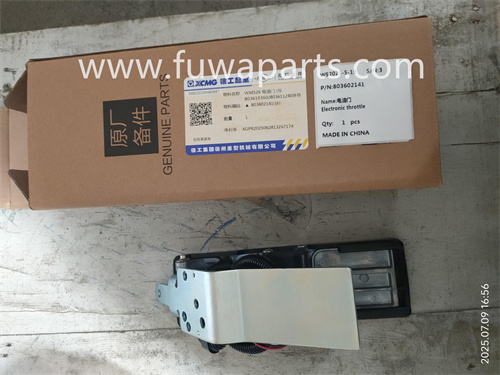
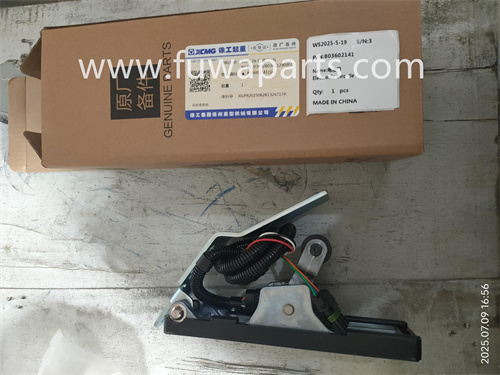
This electronic throttle pedal is the accelerator unit for XCMG all-terrain cranes in the QAY class. Pressing the white pedal plate moves the sensor inside the black housing, and the signal runs down the attached wiring loom, through the plug connector and into the engine controller, which sets fuelling. Nothing on the machine responds until that signal arrives, so a worn pedal shows up as an engine that will not pull rather than as a hydraulic fault.
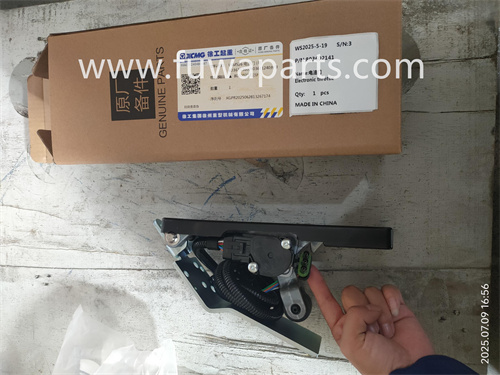
The assembly is a direct replacement for the original. The pedal plate and its black rubber pad, the silver mounting bracket with its fixing holes and the connector on the wiring loom all match the unit already on the machine, so it bolts back into the existing floor position and plugs into the machine's own loom. No drilling, no adapter, no rewiring.
Each pedal is supplied in its printed XCMG carton, one piece to a box, with the XCMG label and the part number on the outside — the same number that is stamped on the unit inside. That label is what a fitter reads at the receiving end, and it is why we ask for a photo of the old part's label rather than a description of the fault.
Most XCMG crane parts are bought against a machine that is already standing, and this one is no different: a fleet workshop or an independent repair shop orders a single piece to get one crane back to work, not a shelf of stock. If your repair list also covers filters, seals, sensors or cab items, send the whole list and we will match each number to the machine before anything is packed.

| Part number | 803602141 |
| Component | Electronic throttle pedal assembly |
| Machine | XCMG QAY220 all-terrain crane |
| Pedal plate | White rectangular plate with black rubber pad |
| Housing | Black pedal housing |
| Mounting | Silver metal bracket with fixing holes, bolt-on |
| Electrical connection | Attached wiring loom with plug connector |
| Packing | One pedal per printed XCMG carton |
| Marking | XCMG label showing the part number |
| Supply condition | Genuine XCMG part |
Two pedals that look the same from the top can differ at the bracket or the plug, so identification comes down to numbers. The unit carries its number on the label, the printed carton repeats it, and the same number appears in the machine's own parts list. Read the number off the part first and the carton second — if the two disagree, the carton has probably been reused.
Construction machinery spare parts numbering is not always tidy. XCMG has superseded numbers over the production life of a model, and an older machine may be carrying a number that has since been replaced. Send the number you have and we will tell you what it crosses to before anything ships; if the number you quote is still current, that is what we send.
When the label on the old pedal has worn away, three details usually identify it: the spacing of the fixing holes on the bracket, the shape and pin count of the plug, and the machine model and serial number from its plate. Photograph all three and send them together — that combination is normally enough for us to confirm the match.
Cabs were built in more than one layout across the production run, so a straight-on photo of the old pedal in place, fixings visible, settles variant questions that no parts list shows. We have been crane parts suppliers to fleets, dealers and workshops since 2017, and the number check is the step that saves the most money: a wrong unit costs a return, a second shipment and another week of downtime.
| Minimum order | 1 piece |
| Payment | T/T; Western Union, or as agreed |
| Lead time | Most parts are in stock — usually 7-20 days, depending on the quantity |
| Trade terms | EXW, FOB, CFR, CIF |
| Loading ports | Shanghai, Dalian, and others |
| Warranty | 2,500 working hours or one year |
| Shipping | Sea, air or express, depending on destination |
| Packing | Export carton for each pedal, labelled with the part number |
Whether a new pedal needs a relearn is decided by the engine controller in your machine, not by the pedal itself. On some QAY220 units the replacement is recognised as soon as it is plugged in and the engine picks up cleanly; on others the controller keeps the idle and full-travel values it learned from the worn unit, and the throttle stays flat or hangs high until those values are reset. Tell us the model and serial number when you order and we will tell you which of the two you are likely to meet, so your fitter can plan the job instead of finding out at the end of it.
Before the swap. Note the idle speed and any dead band at the start of pedal travel, and read out the stored codes from the cab display while the old unit is still connected. That record is the only clean baseline you will have — once the new pedal is in, there is nothing left to compare it against. Photograph the connector at the same time, so you can see later whether a pin was disturbed during the change.
After the swap. With the machine stationary and the park brake on, switch on and watch the pedal percentage if your cab display shows live data: a healthy signal sweeps smoothly across its full range with no step or drop-out. Where the controller offers a pedal learn, run it from the diagnostic menu exactly as the menu instructs and let it finish before touching the throttle. Clear the old throttle codes only after that sweep checks out, because a code left over from the worn pedal will send the next technician down the wrong circuit.
If it still misbehaves. A pedal that reads erratically straight after fitting is more often a disturbed connector, a chafed loom or a poor earth than a second faulty unit. Check the pins, the retaining clip and the earth before you order another crane spare parts item, and send us a short video of the pedal working — our technicians read those quickly and will tell you whether the fault sits in the pedal or in the machine's own wiring. If there is no diagnostic tool on your site, say so before dispatch and we will confirm what your controller needs, so the tool and the right technician are both on hand when the pedal arrives.
Not sure which part fits your machine? Send the part number, the machine model, and a photo of the nameplate or the worn item, and our engineers — each with more than ten years in the construction machinery business — will confirm the correct reference and quote it. We advise on installation, help trace faults, and answer technical questions before and after dispatch. Since 2017 we have built this support on a supplier network covering FUWA, SANY, XCMG and ZOOMLION, so older and hard-to-find references can usually still be sourced.
It fits XCMG all-terrain cranes in the QAY class. Fitment for crane spare parts is fixed by the number on the old unit rather than by the badge alone, so send that number together with the machine model and serial number and we will check it against the XCMG reference before you order. Mobile crane spare parts of this type can also change mid-production, which is why the serial number matters as much as the model. Where a parts list shows two similar numbers for one position, we will tell you which one your machine was built with.
It is the genuine XCMG unit, supplied in its printed carton with the XCMG label and the number on the outside. That matters more on an electronic throttle than on most XCMG crane parts: the track and sensor inside the housing set the signal the controller receives, so a copy that looks identical from the outside can still give a flat spot or a wandering idle. If a price you have been quoted elsewhere looks very low, ask what brand the unit actually is before comparing — the crane electrical parts that fail fastest are usually the ones that were never the right specification.
Yes — it is supplied as one assembly with its wiring, plug connector and metal mounting bracket already attached, so nothing has to be transferred from the old unit. The connector on the machine side is reused, which means the machine's own loom is left untouched. It arrives as a single XCMG spare parts item in its printed carton, and if the same repair needs other mobile crane spare parts, list them against the machine and we will quote each one by number.
That depends on the controller in your machine rather than on the pedal, so tell us the model and serial number when you order and we will confirm what yours needs. On many machines the unit is a straight swap and the engine responds as soon as it is plugged in; where a relearn is required, our technicians will take your fitter through it step by step. If the response is still uneven after fitting, treat it as a wiring question before ordering another crane spare parts item: the pedal is only one of the crane electrical parts in that circuit, and on older machines the plug and the loom are what fail most often.
Cabs were built in more than one layout across the production run, so the safe check is a photo of the old pedal in place, fixings visible, plus one of the connector. Our team compares those against the reference and flags any variant difference before dispatch. We have been crane parts suppliers to fleets and workshops since 2017, and we would rather hold an order for a day than send a unit that has to come back. If the machine has been rebuilt with parts from another series, say so when you send the photos — construction machinery spare parts get swapped between units more often than most operators admit.


