XCMG crane QY70,860150318,500930 LWG-CAN530081 Conversion Circuit Board.

XCMG crane QY70,860150318,500930 LWG-CAN530081 Conversion Circuit Board.
Description

Product Overview

This is the CAN conversion circuit board used in the XCMG QY70 truck crane. It sits in the crane's control circuit and converts the CAN signals that travel between the machine's controllers, its display and its monitoring units — which is why a board failure usually shows up as a crane that will not talk to itself rather than as a mechanical breakdown.

We supply the board new, one board per pack, matched to the references XCMG printed for that panel: 860150318, 500930 and LWG-CAN530081. It is a replacement crane spare part in the plain sense — same board format, same connector layout, same mounting points as the unit you are taking out, so it goes back onto the original rail with the original wiring.

Most orders come from workshops and maintenance teams keeping QY70 units working in a mixed fleet, and from the parts desks that support them. If the same site also needs construction machinery spare parts for other machines, this board can be added to that list instead of being shipped on its own.

Before you order, read the number off your old board and send it with the machine model and serial. We check that reference against the XCMG data for your crane and tell you whether the board you have asked for is the one that belongs in that panel — that check is the difference between a repair and a second breakdown.

Specifications

Product typeCAN conversion circuit board for XCMG crane control panels
Machine applicationXCMG QY70 truck crane
Part number860150318
Cross reference500930, LWG-CAN530081
ConditionNew
Board formatFlat rectangular PCB with edge connector and fixing holes
CoolingFinned heat sink, matte black
ConnectorsMulti-pin sockets and headers for the machine wiring
MarkingPrinted label showing part number, quantity and origin
Pack quantity1 board
MountingMetal rail with fixing holes
FinishGlossy green solder mask

Board Construction & Condition

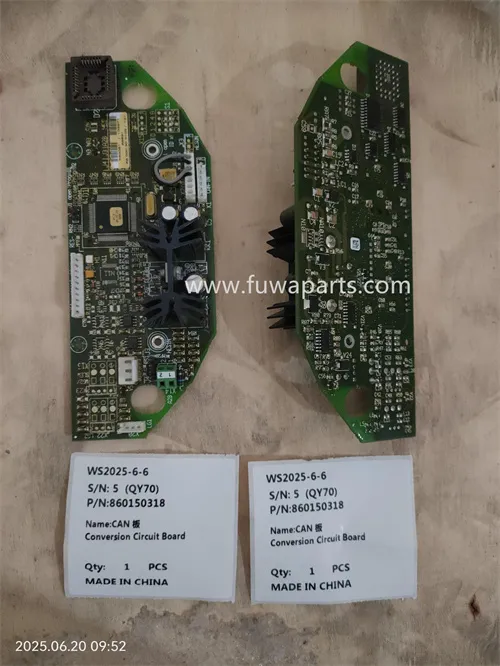
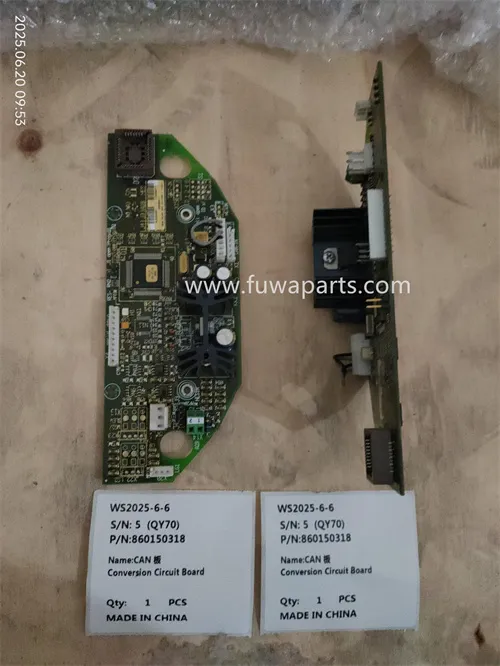
  • Double-sided board. Surface-mount components are carried on both faces of a slim rectangular PCB with an edge connector along one side and fixing holes at the corners.
  • Heat sink fitted. A black finned heat sink covers the section that works hardest, so heat is spread and carried away instead of sitting in the components.
  • Keyed plug connectors. Multi-pin sockets and headers take the machine's original plugs, and the keying means a connector only seats one way round.
  • Mounting rail. A metal rail with fixing holes lets the board sit on the same fixings as the original, so nothing has to be drilled into the panel.
  • Printed label. Every board carries a printed label with the part number, the quantity and the country of origin, so the reference can be read and checked before the board goes anywhere near the crane.
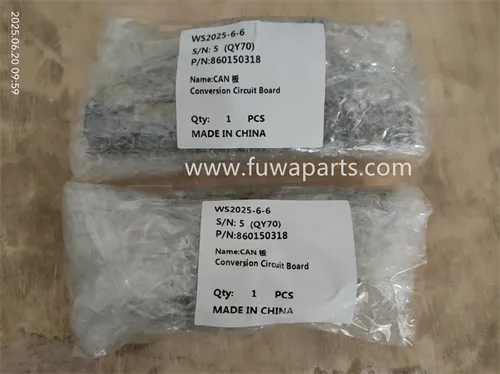
  • Sealed for transit. The board leaves in a sealed plastic bag, one board per pack, which keeps dust and moisture off the contacts until it is opened in the workshop.
  • New condition. This is not a repaired, reworked or salvaged board, and it is not stripped from a scrapped machine.
  • Both faces matter. When you photograph an old board for a match, photograph the front and the back — the label and the connector layout together identify the board.
Front and back views of a green circuit board with labels
Green conversion circuit board with connector assembly and identification labels

Part Number & Fitment Check

Ordering crane electrical parts by machine model alone is where most mistakes start. QY70 cranes were built over a long production run, and the board inside a given panel can change with the build year and the control system fitted. The reliable route is to read the label on the board that has failed and match that number, not the badge on the bonnet.

If the label is burnt, faded or missing, send photographs of both faces, the machine nameplate and the serial number, plus the fault code the display shows. We keep XCMG crane parts for these cranes in stock, but every board is still cross-checked against the factory reference for the machine before it ships — a board that physically plugs in is not necessarily the board that talks to your controllers.

Smaller workshops and crane parts suppliers often order the same board again and again for a fleet. Once a board has been matched to a serial number we keep that match on file, so the repeat order is a one-line message rather than a fresh investigation.

If the number you find does not match anything we list, do not force it. Send it to us anyway; the reference may have been superseded, and we would rather trace the correct board than ship the nearest one.

Fitting & First Power-Up

  1. Park the crane on firm, level ground, lower the boom, shut the engine down and isolate the battery before the crane cabin panel is opened.
  2. Photograph the connector layout and the wiring loom routing before anything is unplugged — that photograph is what gets the machine back together if the job is interrupted.
  3. Release each connector latch by hand and pull the plug by its body, never by the wires, then check the pins for corrosion or a pushed-back terminal while the plugs are off.
  4. Remove the fixing screws, keep them safe, and lift the old board away squarely so the mounting rail is not bent.
  5. Put the new CAN conversion board beside the old one and compare fixing holes, connector count and keying, heat sink position and overall length. If they do not line up, stop and call before fitting.
  6. Seat the board on its rail, start the screws by hand and tighten them evenly; the board should sit flat with no flex under the fixings.
  7. Reconnect the wiring loom, confirm every latch has clicked home, then restore power and start the machine.
  8. Watch the display through the first power-up. The controllers should come up and exchange data as they did before the failure; if the same fault returns immediately, switch off and trace the circuit rather than running the machine.

Fault Tracing Before Replacement

  • Check the supply first. A board starved of voltage behaves like a failed board; measure at the panel with the machine running and confirm the charging system is behaving.
  • Look at the wiring loom before the board. A chafed loom, a pushed-back terminal or green corrosion inside a plug will produce exactly the same lost communication as a dead board.
  • Read the code, not just the symptom. The display code names the node the system has lost, and that node is not always this board.
  • Check the earths. A loose earth at the panel or on the frame gives faults that come and go with vibration and engine speed.
  • Follow the water. A leaking crane cabin roof or a washed-down deck sends water down the loom and into the connectors; if the old board is stained or dull, find the leak before the new one goes in.
  • Borrow a board if you can. Ten minutes with a known-good board from an identical machine tells you more than any amount of reading.
  • Do not buy construction machinery spare parts on a guess. Write down the code, when it appears and what the machine was doing, then send that record to our engineers — they work with overseas workshops every week and will take you through the next check step by step.

Related Parts & Consolidated Orders

Electricalcontrollers, monitors, limiters, sensors, switches, displays and cable assemblies
Hydraulicspumps, motors, valves and cylinders for XCMG machines
Undercarriage
Liftingwire rope, crane sheaves and pulley blocks
Structureboom sections, jib inserts, hook blocks, counterweights and slewing rings
Boom and attachmentparts made to your drawing where the original reference is out of stock
Cabcrane cabin assemblies, glass and interior fittings
Workshopforklift spare parts for Toyota and other yard trucks
Resellersstock orders for crane parts suppliers, dealers and rental fleets
Full rangeconstruction machinery spare parts for cranes, drilling rigs and site plant

Ordering & Delivery

  1. Send the number printed on your old board together with the machine model and serial — we do not ship a crane spare part on a model match alone.
  2. Minimum order quantity is 1 piece, so a single board for a single machine is a normal order; the same one-piece rule covers the rest of our heavy equipment spare parts.
  3. Payment is by T/T; Western Union or as agreed, against EXW, FOB, CFR or CIF terms shipped via Shanghai, Dalian, etc.
  4. Most parts in stock. Usually need 7-20 days, according to the quantity.
  5. Warranty is 2500 Working Hours or One Year.
  6. The board travels bagged inside export packing — a plywood box or sea-worthy crate, cushioned so the connectors never carry the load.
  7. If the same machine is also waiting on an undercarriage part, tell us at the quotation stage and both go on one booking.
  8. Crane sheaves, wire rope and other lifting items ordered for the same site are quoted on the same document.
  9. Workshops that also run forklift spare parts can add them to the consolidated order.
  10. Dealers and crane parts suppliers reselling in their own market can ask for the trade list with the quotation.
Clear plastic bags containing labeled CAN conversion circuit boards

Plugs & Commissioning

  • The board takes the plugs the QY70 was built with: same connector count, same keying, same pin positions and the same edge-connector location. Nothing on the loom is cut, spliced or re-pinned, and a board that would need the loom modified is the wrong board for your panel.
  • Keyed sockets accept a plug in one orientation only. If a latch will not click home, stop and look again — forcing it bends pins, and a bent pin turns a one-hour job into a panel rebuild.
  • Count first, unplug second. Note how many plugs come off the old board and where each one sits, then check that count and the edge-connector position against the photographs before the new board is unwrapped.
  • The machine's own diagnostics read the same nodes as before, because the board is built to the XCMG reference for this panel. Fault codes and live values on the display should come back as they were, not as a new set of messages.
  • If your workshop uses a laptop-based diagnostic kit locked to a particular software release, tell us the kit and the version when you order. We check that combination before dispatch so the board and the laptop are speaking the same language.
  • The board is a hardware item and carries no parameter file of its own — there is nothing to flash into it before fitting. Whether the crane needs a parameter reload or a recalibration afterwards depends on the controller version fitted to your machine and on what was changed while it was down.
  • Give us the serial number and the controller model with your enquiry and we will set out the procedure for that particular build, so the crane is not left half-commissioned on site with the panel open.
  • No laptop is needed to fit the board itself. Fitting is screws and plugs with hand tools; the software question only arises if your controller build calls for a reload, and we tell you that before the board ships rather than after it lands.
  • Our engineers stay with you through selection, installation and commissioning, so the first power-up can be done with someone answering messages on the other end — useful when the nearest dealer carrying crane electrical parts is a flight away.

Technical Support & Model Matching

Not sure which XCMG crane parts fit your machine? Send the part number, the machine model, and a photo of the nameplate or the worn item, and our engineers — each with more than ten years in the construction machinery business — will confirm the correct reference and quote it. We advise on installation, help trace faults, and answer technical questions before and after dispatch. Since 2017 we have built this support on a supplier network covering FUWA, SANY, XCMG and ZOOMLION, so older and hard-to-find references can usually still be sourced.

FAQ

Which XCMG models does this board fit?

It is the CAN conversion board for the XCMG QY70 truck crane. Because XCMG changed the panel layout across the production run, we confirm the board against the number on your old unit rather than the model badge alone, so an early or late machine still gets the right board. For other XCMG cranes and rotary drilling rigs, send the number from the old board or a photograph of its label and we will trace the reference for you.

Do I need to reload parameters or recalibrate after fitting the board?

The board is a hardware replacement built to the XCMG reference for that panel, so it carries no setup routine of its own. Whether the machine needs a parameter reload afterwards depends on the controller version and on what was changed while the crane was down. Send us the serial number and the controller model before ordering and we will tell you what the procedure is for that particular build, so the machine is not left half-commissioned on site.

Can the old board be repaired instead of replaced?

Whether a repair is worth it depends on the damage. If a single component has failed and the board itself is clean and dry, a repair may get the machine running again. If the board is heat-damaged, water-stained or has been repaired before, replace it — that is the same rule we apply across the heavy equipment spare parts we handle. Send clear photographs of both faces and we will tell you honestly what we see.

Will my existing cable plugs fit this board directly?

The board takes the original wiring plugs for this panel: connector count, keying and pin arrangement are the ones the crane was built with, so no wiring modification is involved. Before ordering, compare your old board with the photographs on this product, both faces, and check the connector count and the position of the edge connector. If anything differs, send us a photograph and we will check the reference again before the board ships.

Does the crane's own diagnostic system still read this board?

The machine's display and diagnostic tool read the same nodes as before, because the board is built to the reference XCMG used in that panel. If your workshop runs a laptop-based diagnostic kit with a specific software version, tell us the kit and the version and we will confirm the match before dispatch.

Can it be fitted on site, or does the crane have to come into a workshop?

It is a screw-and-plug job: no soldering, no cutting, no special tooling. A technician with hand tools can change it in the field in dry weather, provided the battery is isolated and the connectors are handled by their bodies. If the panel shows water damage or the wiring has gone brittle, bring the machine in — fitting a new board into a wet panel only repeats the failure.

Review

1/3
X
Subscribe To Get The Latest Quotation
Please leave your email address. We will regularly send the latest catalog to your email.