Product Overview
The XCMG crane sheave is the grooved wheel that carries and guides the hoist rope on an XCMG crane. It sits at the boom tip, in the hook block or on the jib, turning with the rope so the wire runs in a controlled path instead of rubbing across a fixed surface. We supply this sheave as a replacement wheel for XCMG crawler cranes and other heavy machinery, in cast steel or nylon, with the groove and centre bore made to your drawing or sample.
A sheave is a small part with a large effect on rope life. A worn groove, a rough edge or a bore that does not sit square on its pin will wear the wire rope, alter the rope path and shorten the working life of both parts. This is why we quote from dimensions rather than from a photograph alone: outside diameter, groove profile, bore, hub width and mounting arrangement all have to agree with the assembly on your crane.
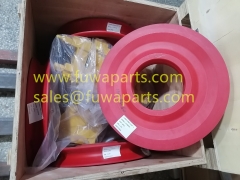
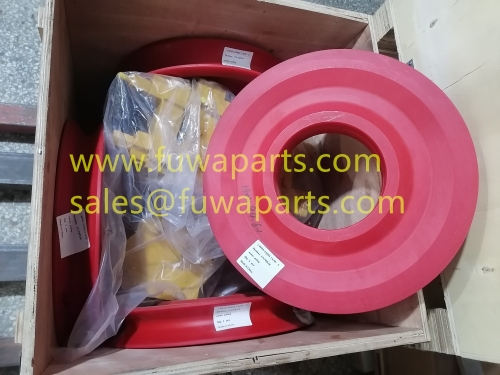
The wheel is a solid circular body with a wide centre opening, finished in red and supplied with the machined groove ready for the rope. It is not a complete hook block or boom assembly; it is the sheave itself, and we can identify the bearing, bushing or pin separately once we know how your assembly is built.
Customers order this sheave for a single replacement after groove wear, for a planned boom overhaul, or as a spare held in the workshop. We also take drawing-based work where the original XCMG reference is no longer readable and the old wheel has to be measured instead. If you are sourcing construction machinery spare parts for a mixed fleet, the same order can include other items from our range.
Materials & Groove Build
- Two materials for the same XCMG crane sheave: Cast steel is the usual choice for main hoist and boom tip positions where load, shock and abrasive grit are part of the job. Nylon is used where a lighter, corrosion-resistant wheel is preferred and the rope load is within its working range.
- Steel grades matched to the duty: Steel sheaves can be produced in the alloy grades we use across our construction machinery spare parts range, including 35SiMn, 35SiMnMo and 28CrMnMo. The grade and heat treatment are agreed before machining, because wear resistance and load capacity depend on both.
- Groove cut to the rope: The groove profile is machined to the wire rope diameter you specify, with the edges dressed so the rope is not cut or scored. A groove that is too wide lets the rope sit low; one that is too sharp wears the wire.
- Bore and hub machined as a set: The wide centre bore, hub faces and outside diameter are checked together so the wheel sits square on its pin. A bore that is off-centre will make the sheave run out and load the rope unevenly.
- Protective finish outside the groove: The wheel is finished in red for identification and surface protection, while the groove is left clean for rope contact. The finish does not replace the correct material or heat treatment.
- New material only: We do not rebuild a worn sheave or cut a new groove into a used wheel. Steel and nylon start from new stock, and the material is confirmed against your application before production.
Drawing & Fit Measurements
- Record the XCMG model, serial number and the reference on the old sheave if it is still readable. A photo of the machine nameplate helps us keep the file straight and match the right crane spare parts to the machine.
- Measure the outside diameter across the full wheel, then the groove diameter at the bottom of the rope seat. Do not measure only the outer edge; the rope sits deeper in the groove.
- Measure the centre bore and the hub width. If the sheave runs on a bearing or bushing, measure the bore with the insert removed and note the insert type.
- Measure the overall width, the thickness at the rim and the position of any spacer, flange or retaining ring. These dimensions decide whether the wheel sits centred in the block.
- Note the wire rope diameter and construction, and photograph the old groove with the rope removed. A worn groove can look wider than it was when new, so send the rope size as well.
- Send a drawing if you have one, in PDF, DWG or a dimensioned sketch. Mark the critical dimensions and the material you want, and we will review the drawing before quoting.
- For a multi-sheave block, count the wheels and identify the position of each one. Sheaves in the same block can differ, so number them before you send photos.
- If you only have the crane model, send photos of the old part from several angles with a tape measure visible. We will tell you which dimensions are still missing.
XCMG Compatibility & Fit Confirmation
As a crane parts supplier, we know an XCMG crane sheave is not selected by model alone. The same model can carry different wheels at the boom tip, hook block and jib, and a previous repair may have changed the block. The reference that matters is the one on the wheel you are replacing, together with the measured groove and bore.
Start with the crane model, serial number and any number stamped on the old sheave, such as 171700536. If the stamping is worn, send a photo of the wheel face and the mounting side. We use those details to check the part against the drawing and to see whether the block uses a bearing, bushing or plain bore.
If the crane has been repaired before, compare the fitted wheel with the other sheaves in the same block. Mixed parts can sit at the wrong height or run with a different rope path. A photo of the complete block helps us catch that before you order.
For a current XCMG model, the model and serial number are usually enough to start the search. For a wheel that has been modified or rebuilt, the old part must be measured. We would rather ask for one more photo than supply a sheave that looks close but runs badly.
Applications & Duty
- Boom tip hoist sheaves: The wheel at the boom head guides the main or auxiliary hoist rope down to the hook block. Groove wear here changes the rope path and should be checked during boom inspection.
- Hook block and travelling block: Sheaves inside the block carry the rope over multiple falls. A matched set of these crane spare parts keeps the rope centred and avoids one wheel taking more load than the others.
- Luffing jib and auxiliary sheaves: Smaller wheels on the jib or auxiliary system are often overlooked until the rope starts to jump. Replace them with the same rope diameter and mounting detail.
- Crawler crane boom maintenance: During a planned boom overhaul, sheaves are usually replaced together with wire rope, pins and bushings. Ordering these construction machinery spare parts as a set reduces repeat dismantling.
- Quarry and construction site duty: Grit, dust and impact shorten sheave life. Cast steel is normally preferred where the wheel sees shock load and abrasive material.
- Port, yard and bridge projects: High-cycle hoisting benefits from a smooth groove and a wheel that runs true. Check alignment and rope condition when a new sheave is fitted.
Related Crane Parts
| Structural components | Hoist winches, counterweights, lifting hooks, crane booms, slewing ring bearings |
| Undercarriage parts | Track rollers, idlers, sprockets, tension devices |
| Transmission and control | Wire ropes, crane sheaves and pulleys, clutches, brakes, bushings |
| Hydraulic parts | Electrical Parts |
| Electrical parts | Cables, monitors, controllers, limiters, sensors, switches |
| Maintenance parts | Planetary Parts |
| Engine and planetary parts | Engine parts, planetary gears |
| Crane cabin and drive cab | Operator cabins and drive cabs for crane and excavator applications |
Ordering & Delivery
- Minimum order: 1 piece.
- Payment: T/T; Western Union or as agreed.
- Lead time: Most parts in stock. Usually need 7-20 days, according to the quantity.
- Shipping terms: EXW, FOB, CFR, CIF; shipped via Shanghai, Dalian, etc.
- Warranty: 2500 Working Hours or One Year.
- Bulk orders: Volume pricing is available on larger orders of crane sheaves or project sets; ask your sales contact for a quantity-based quote.
- Urgent delivery: If a crane is down, ask about priority air freight. We will confirm the fastest option and any extra cost for your destination.
- Packing: The wheels are stacked and braced in an export wooden crate, with smaller fittings bagged and labelled. The crate label carries the item number, quantity, size and country of origin, so check it against your order on arrival.
- Custom drawings: Send the drawing before the order is placed so the groove, bore and material can be reviewed. Drawing-based work is scheduled after the drawing is approved, and we will confirm the date with your order.
- Consolidated orders: As a crane parts supplier, we can combine this sheave with wire rope, pins, bushings and other crane spare parts in one shipment.
- Export markets: We ship to Europe, the Middle East, Africa, Southeast Asia and other markets. Confirm the nearest port and terms for your order.
Installation & Maintenance
- Clean the block, pin and bushing before fitting the new sheave. Grit left on the pin will make the wheel run off-centre.
- Check the groove against the rope and confirm the bore fits the pin or bearing without force. The sheave should sit square, with the correct spacer or retaining ring in place.
- Align the sheave with the lead-in rope so the wire enters and leaves the groove without rubbing the flange. Check the rope path through the whole block, not only at the new wheel.
- Rotate the sheave by hand after assembly. It should turn freely with no bind, rock or contact with the block side plates.
- Run the crane through a slow hoist cycle and watch the rope seat in the groove. Stop if the rope jumps, twists or rubs against a shoulder.
- During routine inspection, look for a polished groove, a step at the groove edge, cracks around the bore and rope wear. A groove that has become too wide or sharp means the sheave or rope needs attention.
- Keep the groove clean and follow the rope manufacturer's lubrication instruction. Do not pack grease into a nylon sheave groove unless the rope maker specifies it.
- After the first working shifts, recheck the retaining ring, mounting bolts and rope condition. Re-torque fasteners to the crane manufacturer's figure, not a generic value.
Arrival Inspection
- Inspect the crate before you sign for it: look for crushed corners, split boards, water staining or a broken brace, and note any damage on the delivery receipt. Photograph the crate as it arrived, then unpack and photograph the wheel again before the packaging is cleared away.
- Lift the wheel by the hub or the outer rim with a sling or strap, never by the rope groove, and do not drop it onto concrete. A cast steel wheel can chip at the rim and a nylon wheel can crack at the bore even when the impact looks minor.
- Check both faces of the wheel once it is out of the crate: the red finish should be intact, the groove clean and dry, the groove edges free of burrs, and the bore free of tool marks or bright rub marks from movement in transit.
- Measure it before fitting. Use a caliper for the outside diameter, the groove diameter at the bottom of the rope seat, the bore and the hub width, then compare those figures with the drawing or the values you ordered. If the old wheel is still on the bench, stand the two side by side: a difference in groove depth or hub width is easy to see.
- Check that the wheel runs true. Mount it on a clean pin or mandrel, or lay it flat on a surface plate; a wheel that rocks, or shows visible runout at the rim, should not go into service.
- Seat a short length of the actual wire rope in the groove. The rope should sit with its top roughly level with the rim flanges and should not rub either flange. If the rope sits low or rides on the flanges, stop and send us a photo of the rope seated in the groove.
- Keep a record of what arrived: photograph the wheel face, the bore and the groove with a tape measure in shot, and file the set with the machine history. If a mismatch or a warranty question comes up later, these photos and the measured values resolve it far faster than a description.
- If anything does not match the order, do not fit the wheel. Contact us with the photos and measurements first, because wear or load marks from service make it harder to establish the condition in which the sheave was supplied.
- Store spare wheels flat and off the ground in a dry place, with the groove lightly protected against rust, and keep nylon wheels out of direct sun and away from heat sources until they are needed.
Technical Support & Model Matching
Not sure which part fits your machine? Send the part number, the machine model, and a photo of the nameplate or the worn item, and our engineers — each with more than ten years in the construction machinery business — will confirm the correct reference and quote it. We advise on installation, help trace faults, and answer technical questions before and after dispatch. Since 2017 we have built this support on a supplier network covering FUWA, SANY, XCMG and ZOOMLION, so older and hard-to-find references can usually still be sourced.
FAQ
How do I confirm the sheave will fit my XCMG crane?
The fit is decided by the groove, bore, outside diameter and mounting, not by the model alone. Send the crane model, serial number and a photo of the old wheel with a tape measure visible; we will tell you which measurements are still needed.
Can you supply a sheave for an older XCMG crane?
Yes. If the part number is no longer listed, send a photo of the old sheave, its measurements and any stamping on the wheel. We can match it from the sample or produce a replacement from a drawing.
Which material is better for my application, cast steel or nylon?
For main hoist and boom tip positions on a working crane, cast steel is the usual starting point because it handles load, shock and grit. Nylon suits lighter duty where a non-metallic wheel is preferred and the rope load is within its range. Tell us the rope size and how the crane works, and we will recommend one.
Can you make the sheave from our drawing?
Yes. Send a PDF, DWG or dimensioned sketch with the groove, bore, outside diameter, hub width and material marked. Our engineers review it before quoting and will ask about any dimension that is not clear.
How is the groove matched to the wire rope?
We need the rope diameter and, where possible, a photo of the old groove with the rope removed. The groove is machined to suit that rope size; a groove that is too wide lets the rope sit low, while a sharp or narrow groove wears the wire.
Does the sheave come with a bearing or bushing?
The sheave is supplied as the machined wheel. The bearing, bushing, pin, spacer, thrust washer and retaining ring are separate items, and we confirm them against your assembly rather than fitting hardware by default. The reason is practical: on the same XCMG model, a boom tip sheave and a hook block sheave can use quite different hubs. Some run a caged roller bearing pressed into the hub, some a bronze or steel-backed bushing, and some a plain bore riding on a hardened pin with a grease path. Sending a wheel with the wrong hardware could tie it to an assembly it was never meant for.
What to send us
A photo of the mounting showing how the wheel is held in place is the quickest start. Alongside it, the bore diameter, hub width and pin diameter let us match the hardware. If the old bearing still carries a number stamped on its race or seal, send that as well, and tell us whether the mount has a grease nipple or a drilled lubrication channel. With those details we can confirm whether your block uses a bearing, a bushing or a plain pin arrangement, and quote the matching parts with the wheel.
If you want the bearing supplied with the sheave
Give us the bearing reference before the bore is machined. The bore is sized to that bearing's outer diameter and the hub width to its width, so changing the hardware afterwards means re-machining the wheel. We can quote the sheave and its hardware together as a matched set once the reference is known.
If you are reusing the old bearing
Press it out rather than driving it with a hammer, and check the races for pitting, discolouration or roughness before it goes back in. A worn bearing will wear a new bore and make the wheel run out, so if the seal is gone or the rollers feel rough, replace it at the same time.
Can I replace one sheave without changing the whole set?
Yes, a single wheel can be replaced when the adjacent crane sheaves and the rope are still within service. Inspect the other wheels at the same time; if several show groove wear, replacing them as a set avoids a second shutdown.
How is this sheave different from a generic replacement wheel?
A generic wheel may share the outside diameter but differ in groove, bore or hub width. This XCMG crane sheave is quoted from your old part, drawing or measurements, with cast steel or nylon chosen for the duty and the groove cut to your rope. That is the difference between a wheel that bolts on and one that runs true.
What should I check when the sheave arrives?
Check the crate label against your order, then look at the groove and bore for transit damage before fitting. Confirm the bore, outside diameter and groove against the drawing; if anything does not match, stop and contact your sales contact with photos.
How do I look after a sheave in service?
Keep the groove clean, watch for rope wear and check that the wheel turns freely. A groove that becomes polished with a sharp edge, or a wheel that rocks on its pin, needs attention before it damages the rope.