


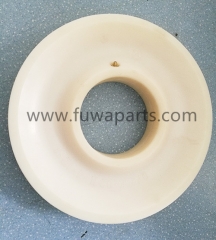
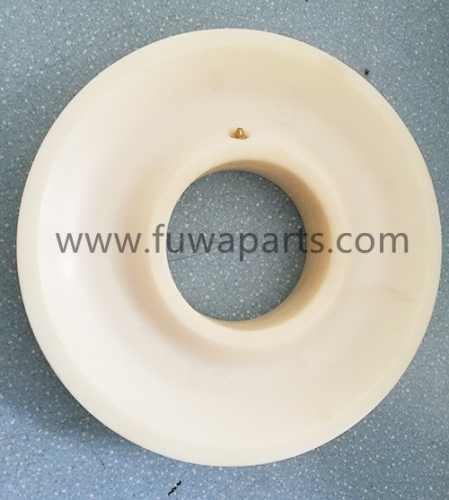
A sheave is the grooved wheel the hoist rope runs over, and on an XCMG crane the boom head sheave sets how the rope leaves the boom, how the load passes through the block and how quickly the rope itself wears. Crane sheaves look simple from the outside; inside the reeving they are the part that decides whether a rope runs true or rubs itself flat against a worn groove.
This is the wire rope hoisting sheave for that position — a new part, not a reconditioned one, made to the groove profile, outer diameter and bore of the original so it goes back onto the same bracket, pin or shaft. Workshops fit it during a rope change, a boom rebuild or a hook-block overhaul, and fleet stores keep one on the shelf so a worn groove does not park a machine. Because it is one of the crane spare parts that is replaced on condition rather than on a schedule, the reference for the position matters far more than the model name alone.
That is also why we work as heavy equipment spare parts suppliers rather than as a catalogue: the part number, the machine model and a photo of the old sheave are checked against the XCMG drawing before anything is quoted, and the material is settled at the same time.
| Model family | XCMG models |
| Crawler cranes | QUY50, QUY80, XGC100, XGC150, XGC260, XGC400, XGC650 |
| Truck cranes | QY25K, QY50K, QY70K |
| All-terrain cranes | XCA100, XCA220 |
| Rotary drilling rigs | XR150D, XR220D, XR280, XR360 |
| Crane sheave positions | Boom head, jib tip, auxiliary tip and hook block sheave reeving across the crane families above |
| Rotary drilling rig parts | Mast head and hoist rope guidance points on the rig |
| Legacy and unlisted models | Sourced from the part number, or made to drawing when the original is discontinued |
| XCMG machines outside this list | Covered from the model and part number, matched against the parts book for that machine |

Most orders that start with a sheave end up carrying more than one line. Working as crane parts suppliers to fleets and repair workshops rather than as a single-part counter, we consolidate XCMG, SANY, ZOOMLION and FUWA items into one shipment, so freight is booked once and the customs paperwork covers the whole lot.
Running gear is the usual companion order: undercarriage parts for the same carrier — track shoes, track rollers, upper and lower rollers, idlers and drive sprockets — supplied against the same machine reference so the wear parts arrive together.
Structural items come next. Boom sections, jib inserts, hook blocks, link panels and pins sit in the same crane spare parts range, which means a boom rebuild can be quoted as one list instead of four separate enquiries.
Operator-area items are available too: complete crane cabin assemblies and the fittings around the operator station, matched to the XCMG model rather than bought as a generic cab part.
Workshop consumables and other brands fill out the rest. Filters, seal kits, repair kits and Toyota forklift spare parts are stocked alongside the crane lines, which suits a workshop that services more than cranes.
For a mixed yard this means one supplier carrying heavy equipment spare parts across several machine types, with the same reference checking applied to a track roller as to a sheave.
Nothing on that list is quoted from a model name alone — the same discipline used on a sheave applies to every construction machinery spare parts line we send out, so the box that arrives matches the machine in the yard.
| Term | Detail |
| Minimum order | 1 piece |
| Stock | Most parts in stock |
| Lead time | Usually 7-20 days, according to the quantity |
| Payment | T/T; Western Union or as agreed |
| Trade terms | EXW, FOB, CFR, CIF |
| Loading ports | Shanghai, Dalian and other ports as arranged |
| Warranty | 2,500 working hours or one year |
| Packing | Sea-worthy wooden crates or steel frames |
Not sure which part fits your machine? Send the part number, the machine model, and a photo of the nameplate or the worn item, and our engineers — each with more than ten years in the construction machinery business — will confirm the correct reference and quote it. We advise on installation, help trace faults, and answer technical questions before and after dispatch. Since 2017 we have built this support on a supplier network covering FUWA, SANY, XCMG and ZOOMLION, so older and hard-to-find references can usually still be sourced.
The sheave is usually one line of a larger order. We supply undercarriage and other XCMG crawler crane parts for the same carrier — track shoes, rollers, idlers and sprockets — plus boom and jib sections, hook blocks, hydraulic and electrical items, and crane cabin assemblies. Buyers running mixed fleets also add Toyota forklift spare parts to the same shipment, which keeps the freight to a single booking.
The groove is cut to the rope diameter your machine runs and to the XCMG reference for that position; it is not a generic profile shared across construction machinery spare parts. A groove that is too wide lets the rope flatten and wear early, while one that is too tight pinches the strands. When the number has worn off, send the rope diameter and the groove measurement from the old sheave and the match is made from those.
It depends on the position. Some XCMG sheave assemblies carry a separate bushing or bearing and some run straight on the pin, so the sheave is supplied to match what the original uses. Send a photo of the bore and the pin, and we confirm what comes with the part before it ships — that way you are not paying for a bearing you already have, or waiting on one you did not expect.
Our engineers stay with the job after the sheave ships: how it seats in the block, which way the insert faces, rope alignment in the groove, and what to check if a new sheave starts running warm or the rope tracks to one side. Send photos or a short video of the assembly and the team will work through it with you. For buyers outside China this runs over email and messaging, with inquiry support around the clock.
In this trade the two words are used interchangeably — crane sheaves and crane pulleys both describe the grooved wheel the rope runs on. What matters when ordering is the position and the reference: a hook-block pulley and a boom-head sheave for the same machine are different parts with different diameters and groove sizes. Give us the position as well as the part number and the two cannot be mixed up.


