




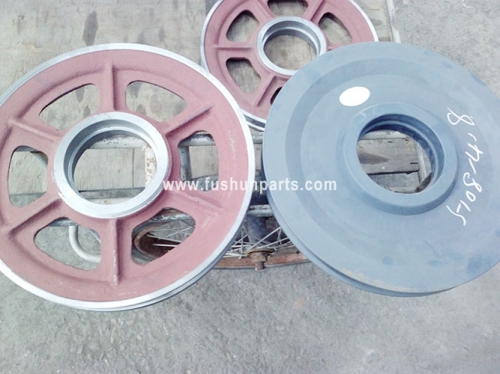


What it does on the crane
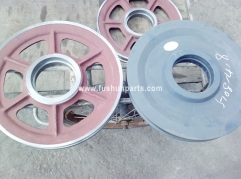
A wire rope sheave is the grooved wheel that carries and redirects the hoist rope. You will find one at the boom head, one at the jib tip, several inside the hook block, and usually a guide wheel where the rope leaves the drum. The rope runs in the groove, the rim takes the load, and the bore turns on a pin or a bearing. Once the groove wears deep the rope sits lower, the flange starts to climb, and the reeving runs rough — that is normally the moment a replacement is ordered.
What this one is
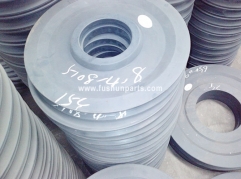
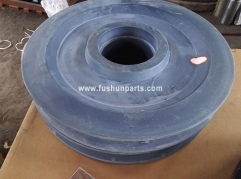
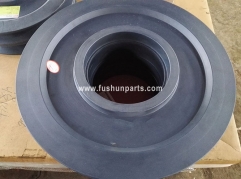
These crane sheaves are made for crawler cranes in steel and cast iron, or as an MC nylon sheave, with the outside diameter, rim width, groove and bore machined to the dimensions you give us. Coverage runs across the Fuwa, Sany, Zoomlion, XCMG, Hitachi, Sumitomo and Demag machine ranges, so a workshop handling a mixed fleet can put several sizes on one shipment instead of chasing each brand separately.
Why made to dimension
On an older machine the plate is often painted over, the number is gone and the drawing was lost years ago. Because heavy equipment spare parts like this are cut to order rather than picked off a shelf by a number, we can work from a drawing, from a photo of the old wheel with a rule laid across it, or from the measurements you take in the workshop. That is how a crane that came off the production line a decade ago keeps earning.
As a crane parts supplier working with workshops and fleet operators, we handle a single wheel and a full hook-block set the same way: confirm the dimensions, machine the wheel, ship it.

| Crane brand | Model ranges |
| Hitachi | KH100, KH125, KH150, KH180, KH230, KH250, KH300, KH500, KH700, CX300, CX500, CX550, CX650, CX700, CX900, PD7, PD100 |
| Sumitomo | SC350, SC400, SC500, SC550, SC650, SC700, SC800, SC100, SC1500, LS13RH, LS78RM, LS78RH5, LS78RHD5, LS98, LS108RM, LS110C, LS118RH3, LS118RH5, LS120RH5, LS138H, LS138RH5, LS208H, LS218H, LS218RH5, LS238RH2, LS238RH3, LS238RH5, LS458HD, LS468HD, LS518, LS528, SD205, SD307, SD407, SD610 |
| Hitachi-Sumitomo | SCX300, SCX400, SCX500, SCX700, SCX800, SCX900, SCX1200, SCX1500, SCX2000, SCX2500, SCX2600, SCX2800 |
| Demag | CC1000, CC1200, CC1400, CC1500, CC1800, CC2000, CC2200, CC2500, CC2800, CC4000, CC5800, CC6800 |
| Fuwa | QUY35, QUY50, QUY70, QUY80, QUY90, QUY100, QUY120, QUY150, QUY250, QUY320, QUY400, QUY500, QUY650, QUY750, QUY1250 |
| Sany | SCC500, SCC550, SCC600, SCC700, SCC750, SCC800, SCC1000, SCC1250, SCC1500, SCC1800, SCC2600, SCC3000, SCC4000, SCC5000, SCC6500, SCC7500, SCC8100, SCC8200, SCC8300, SCC10000, SCC16000 |
| Zoomlion | QUY35, QUY50, QUY70, QUY80, QUY90, QUY100, QUY120, QUY130, QUY150, QUY180, QUY250, QUY320, QUY400, QUY500, QUY650, QUY750, QUY1250 |
| XCMG | QUY 38–350 ton |
Where the wear shows
Groove wear is the ordinary failure: rope pressure widens and deepens the groove, the rope sits lower, and the effective diameter of the wheel shrinks. From there rope and wheel wear each other, and a hoist that felt smooth starts to run rough. Flange wear is the dangerous one — a flange worn thin lets the rope climb out during a slack moment. A seized bearing or bushing is the sudden one: the wheel stops turning, the rope skids across it, and a flat burnished patch appears on the rim. On a machine that works hard, a failed hoist rope sheave turns into an urgent construction machinery spare parts search while the crane stands.
What to check at inspection
Slack the rope and turn the wire rope sheave by hand: it should run free with no rock in the bore. Watch how the rope sits in the groove — proud means a shallow groove, sunk means a worn one. Compare groove depth across every wheel in the same block, because when they no longer match the rope twists as it passes through. Check flange height against a new wheel, and look for pitting on steel rims working near water.
Repair or replace
Light, even wear can sometimes be re-grooved, but once the flange, the bore or the bearing seat has gone, a new wheel is the cheaper route. If the rope has been running in a badly worn groove, plan to change the rope together with the wheel. A worn sheave is one of those heavy equipment spare parts that are easy to postpone and expensive to ignore, and noting the date and running hours each time shows how long the wheel actually lasted.
| Item | Detail |
|---|---|
| Condition | 100% new |
| Minimum order | 1 piece |
| Order intake | Drawing, a photo of the old wheel with a rule laid across it, or measurements taken in the workshop |
| Dimension sign-off | Groove profile, outside diameter, rim width and bore repeated back to you for confirmation before machining starts |
| Payment | T/T; Western Union or as agreed |
| Lead time | Most parts in stock; usually 7-20 days, according to the quantity |
| Stock status | Checked size by size once your list is in, so you know what ships now and what goes to machining |
| Trade terms | EXW, FOB, CFR, CIF |
| Port of loading | Shanghai, Dalian, etc. |
| Packing | Pallet, with the wheels braced and wrapped so machined bores and grooves arrive clean |
| Shipping documents | Prepared to suit the trade term you choose |
| Warranty | 2500 working hours or one year |
Not sure which part fits your machine? Send the part number, the machine model, and a photo of the nameplate or the worn item, and our engineers — each with more than ten years in the construction machinery business — will confirm the correct reference and quote it. We advise on installation, help trace faults, and answer technical questions before and after dispatch. Since 2017 we have built this support on a supplier network covering FUWA, SANY, XCMG and ZOOMLION, so older and hard-to-find references can usually still be sourced.
Yes — the groove is cut to the rope diameter you give us, and it is the one measurement we will not guess. A groove that is too wide lets the rope flatten and lose its shape, while one that is too narrow pinches the strands and wears rope and wheel together. Send the rope diameter with your enquiry, and if you are changing rope size at the same time, tell us the new size rather than the old one.
Either works. A dimensioned drawing is the cleanest route and we machine straight to it. Without one, send the worn wheel or clear photos with a rule across the face, plus the bore, hub width and groove measurements — on an older machine a worn crane spare part is often the only reference left. Dimensions come back to you for confirmation before anything is cut.
Fuwa, Sany, Zoomlion, XCMG, Hitachi, Sumitomo and Demag crawler crane ranges, and the model list on this product shows the machines we have supplied crane sheaves for. Our wider construction machinery spare parts range covers the same brands. If your model is not on the list, send the machine details and the old wheel measurements and we will check what we can machine for it.
Match what the crane was built with unless you have a reason to change. Steel and cast iron suit the boom head and hook block, where the rope load is highest. MC nylon is chosen where block weight matters or where the machine works wet and rust is a nuisance. Swapping material changes the weight in the block and the way the rope runs, so ask us to confirm before you switch a whole set over.
The sheave is supplied as the wheel. Bearings, bushes, pins, collars and brackets differ from one block design to the next, so tell us which block the wheel goes into and we will confirm exactly what needs to come with it on the same order.


