


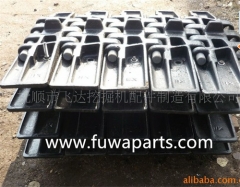
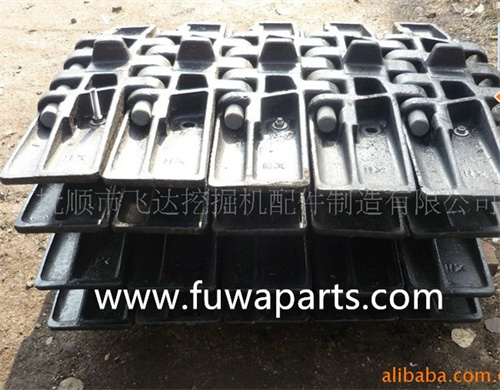

A crawler crane puts its whole working weight into the ground through the track shoes bolted around its chain. Each shoe is a cast alloy plate that spreads that load across a wide contact patch and bites in with raised ribs, so the machine stays level on soft ground and keeps its grip when it tracks along a slope or swings a load on hard standing.
This one is the replacement plate for Hitachi KH-series crawler crane undercarriages. The bolt-hole pattern, mounting face and overall length follow the original, so it goes onto the existing chain link in place of a worn or damaged shoe, and the raised centre ribs keep the ground-engaging profile the chain was designed around.
Most plates are bought a handful at a time after an undercarriage inspection, or as a full set when a chain is re-shoed. Fleet operators usually keep one or two spares per machine on site, because a single cracked or badly worn shoe can hold a crane out of service until a replacement lands. We work as a crane parts supplier for Hitachi, Sumitomo, Hitachi Sumitomo, FUWA and SANY crawler cranes, so a single order of heavy equipment spare parts can cover a mixed fleet rather than one brand at a time.


Choosing between the three grades. 35SiMn is the manganese-silicon grade used across this class of cast undercarriage part and covers general construction, yard and road work. 35SiMnMo adds molybdenum, which gives a better response to heat treatment and more toughness under repeated impact — the usual pick for quarry floors, slag and demolition debris. 28CrMnMo is the chromium-molybdenum option, chosen where a harder, more abrasion-resistant running face is the priority. Tell us what the machine works on and we will point you at one; between them these grades cover most of what buyers of this class of heavy equipment spare parts ask for.
What the heat treatment is doing. Hardening the running face raises wear resistance where the plate meets stone and grit, while a tough body stops the plate shattering when a rib catches an edge. The two have to be balanced, which is why grade and treatment are chosen together rather than separately.
Surface finish before it ships. Every plate is shot-blasted, which removes sand, scale and casting skin from the ribs and the mounting face. The anti-rust coating goes on afterwards, so the plate is clean when it reaches your workshop and the coating has something to grip on in transit.
Checks before packing. Casting grade against the order, bolt-hole spacing and diameter against the drawing, flatness of the mounting face, and rib profile. A plate that fails any of these is rejected before it reaches the packing bench. If your maintenance system needs material or dimensional records for the file, ask your sales contact what can travel with the shipment.


| Parameter | Details |
|---|---|
| product | 9025831 |
| Article number | 118702 |
| OEM reference | 9025831 |
| OEM | Hitachi |
| Brand | Hitachi |
| Machine type | Crawler cranes |
| Machine | Hitachi KH125-2 |
| Product group | Crawler parts |
| Part type | Track shoes |
| Material options | 35SiMn / 35SiMnMo / 28CrMnMo |
| Surface treatment | Shot blasting + anti-rust coating |
| Shoe length | 760 mm |
| Load capacity | Customizable per OEM requirements |
| Applications | Mining sites, port logistics, bridge engineering, oilfield operations |


Where these plates wear fastest. Hard rock floors in quarries and mining pits grind rib height down and chip the plate edges. Port and yard work on concrete polishes the running face and slowly opens the bolt holes. Bridge and road projects drop rebar offcuts and broken concrete under the chain, which catch the plate and bend it rather than wear it. Oilfield pads add mud and spillage that attack the coating long before the steel is worn. The plate is doing its job in all four settings, but the wear pattern it leaves tells you what to check next.
What to look at during an inspection. Compare rib height on the worn plate against a new one; once the ribs are flush with the body, both grip and flotation are gone. Look for cracks starting at the corners of the bolt holes, holes that have gone oval, and plates that have dished so they no longer sit flat. Run a hand along the row after the machine has tracked — a plate rocking on its link will have loosened bolts.
Replace by section, not one plate at a time. Shoes wear as a group. Dropping a single new plate into a worn set changes the chain's rolling diameter at that point, and the new plate ends up carrying more than its share of the load. Re-shoe across a whole section and keep the plates that still have usable rib height as spares.
Retension after fitting. A re-shoed chain settles in the first few hours of tracking. Check chain tension again once the machine has run, and re-torque the bolts to the figure in your manual.
The parts that wear with them. Track shoes rarely fail alone, so we supply the rest of the undercarriage parts in the same order: track rollers, upper and lower rollers, idlers, drive sprockets and track chains. Mixed fleets can add crane sheaves and other construction machinery spare parts to the same shipment, which keeps wear rates balanced across the machines instead of one component always running ahead of the others.


Sumitomo coverage runs across three naming groups. The SC models — SC350, SC400, SC500, SC550, SC650, SC700, SC800, SC100 and SC1500 — are the classic crawler crane designations, and the plate grows from the SC350 and SC400 end up to the SC100 and SC1500. The LS group is the longest list: LS13RH, LS78RM, LS78RH5, LS78RHD5, LS98, LS108RM, LS110C, LS118RH3, LS118RH5, LS120RH5, LS138H, LS138RH5, LS208H, LS218H, LS218RH5, LS238RH2, LS238RH3, LS238RH5, LS458HD, LS468HD, LS518 and LS528. The SD models — SD205, SD307, SD407 and SD610 — close the range.
Because these groups span a long production history, the same nominal model can appear with more than one chain and shoe combination, which is the usual reason a Sumitomo crane spare parts order comes back with the wrong plate. Quote the machine's serial number and, if you still have it, the number off the old plate. If you are working from a parts book rather than from the machine itself, send the product and we will match the reference for you.
FUWA coverage follows the QUY range: QUY35, QUY50, QUY70, QUY80, QUY90, QUY100, QUY120, QUY150, QUY250, QUY320, QUY400, QUY500, QUY650, QUY750 and QUY1250. The number in the model tracks the crane's size class, so the plate that goes on a QUY35 is a different animal from the one on a QUY400 — width, thickness and the number of shoes per side all change as the machine gets bigger.
QUY cranes turn up in exactly the places these plates are bought for: precast yards, ports, bridge erection and general heavy lifting. If you run a mixed FUWA fleet, order by model and serial and we will keep the references separated so a QUY70 plate does not end up in a QUY80 box — the mix-up a crane parts supplier sees most often on multi-machine orders. The surrounding undercarriage parts are available in the same order: rollers, idlers, sprockets and chains.
| Minimum order quantity | 1 piece |
| Availability | Most parts in stock |
| Lead time | Usually 7-20 days, according to the quantity |
| Payment | T/T; Western Union or as agreed |
| Trade terms | EXW, FOB, CFR, CIF |
| Loading ports | Shanghai, Dalian, etc. |
| Packing | Export plywood box |
| Warranty | 2500 working hours or one year |
| Fitment check | Machine model, serial number and the number stamped on the old plate |
| Custom sizes | Accepted against a drawing or a sample plate |
| Order confirmation | Proforma invoice listing part numbers, quantity and trade term |
| Shipping method | Sea freight, air freight or courier, quoted per order |
| Consolidation | Mixed crane parts and forklift spare parts from one order packed together where crate size allows |
| Documents | Packing list, invoice and material test reports on request |

Not sure which part fits your machine? Send the part number, the machine model, and a photo of the nameplate or the worn item, and our engineers — each with more than ten years in the construction machinery spare parts business — will confirm the correct reference and quote it. We advise on installation, help trace faults, and answer technical questions before and after dispatch. Since 2017 we have built this support on a supplier network covering FUWA, SANY, XCMG and ZOOMLION, so older and hard-to-find references can usually still be sourced.
This plate is supplied new — not reconditioned, not welded up and not taken off another machine. That matters on a wear part: a rebuilt plate usually has rib height already worn back and bolt holes that have been opened out, and it will not hold torque the way a fresh casting does. Check flatness and bolt torque again after the first few hours of tracking, whether the plate is new or not.
For quarry floors, slag and demolition debris we normally suggest 35SiMnMo: the molybdenum addition gives more toughness under repeated impact while the running face is still hardened for abrasion. Abrasive but lower-impact ground — concrete yards, asphalt, hard standing — is usually served well by 35SiMn alone, and 28CrMnMo is the option when wear resistance matters more than impact toughness. Tell us the site conditions and the plate you are replacing and we will confirm the grade with you.
Only on the mounting face. The coating is there to protect the plate in storage and on the water, and coating trapped between plate and link can stop the two faces seating flat and let the bolts work loose. Clean it back to bare metal where the plate meets the link. On the ground-engaging side it wears off by itself within the first hours of tracking, so there is no need to strip it.
Usually yes, provided the chain itself is still inside its wear limits. Trouble comes from a chain whose pins and bushes have elongated the pitch: the new plate then sits slightly out of step with its neighbours, and the mismatch shows up as uneven running and bolts that keep loosening. Measure chain pitch before you re-shoe — if it is past the limit in your manual, new plates alone will not fix the ride.
Yes. Send a dimensioned sketch or a drawing with bolt-hole spacing, overall length, plate thickness and rib profile marked, and we will work from that. A photo of the old plate with a rule laid against it also helps us confirm the dimensions before anything is cut, which is often the faster route when the original drawing is long gone.
On most crawler cranes, yes — the chain is slackened, the machine is blocked, and the plate is swapped on the link. It is heavy, awkward work rather than skilled work, and the part that matters is the torque figure: tighten to the setting in your manual and re-check after the machine has tracked for a few hours. If the link itself is worn or the bolts are seized, it turns into a workshop job.


