Product Overview
A drive cab takes more punishment than almost any other part of a crane: sun, dust, stone chips thrown up by the load, and a door that is opened and slammed a hundred times a shift. When the cab on a SANY, ZOOMLION, XCMG or FUWA machine is cracked, rusted through or simply worn out, a crane cab replacement is usually faster and cleaner than patching panels. What we supply here is a complete operator enclosure built to the dimensions of the machine it is going onto, so the door, the glazing and the mounting points line up with the original structure instead of being made to fit on site.
It is used on the 50-ton class of crane and excavator and on larger carriers, across crawler cranes, truck cranes and heavy excavators. These four brands share a lot of geometry but not all of it, so every order starts from the machine model rather than from a generic size. The cab is one line in a wider construction machinery spare parts programme that also covers crane lattice booms, hoist winches, lifting hooks, slewing ring bearings and undercarriage parts, which means a fleet can be resupplied without opening four separate purchase orders.
Cab Shell & Glazing
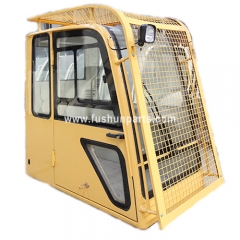
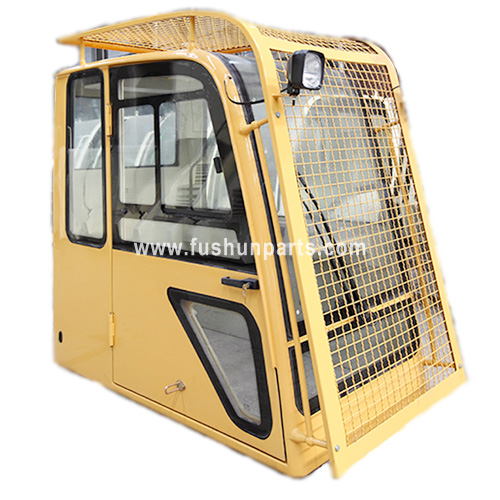
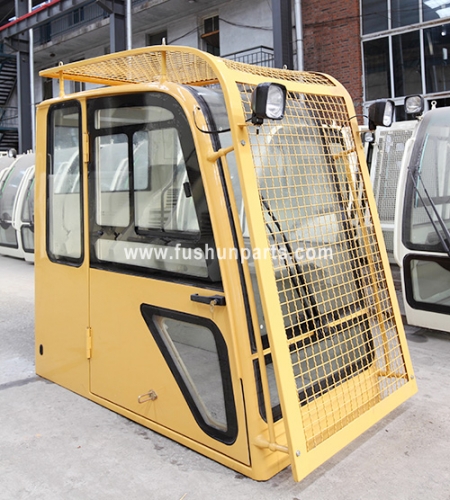
- Welded steel enclosure. The shell is a welded box in cast and alloy steel, with the door hung on the side your machine needs; the operator, the glazing and the controls all sit inside one assembly, so alignment problems stay in one place instead of spreading across the deck.
- Glazing in rubber seals. The windows sit in black rubber seals rather than being bonded flush, which is what lets a single pane be swapped after a stone strike without cutting the frame out.
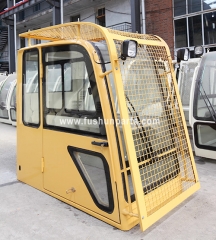
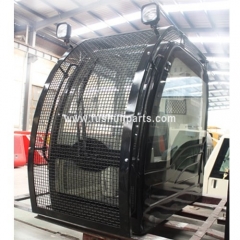
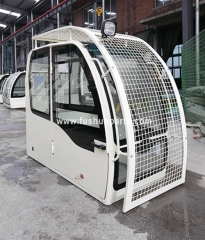
- Front mesh guard. The crane cabin shown in our photographs carries a mesh guard across the windscreen — the detail worth specifying for demolition, quarry and scrap work where debris reaches the glass every day.
- Door, latch and handle. A hinged side door with a proper latch and grab handle lets an operator get in and out in boots and gloves; on a used cab, the hinge is the first thing to check before deciding between repair and a crane cab replacement.
- Roof canopy and work light. The roof is a flat canopy carrying a work light, so a night shift on a yard or a bridge site does not depend on a lamp bracket being welded on afterwards.
- Mirror and finish. A side-mounted mirror comes with the cab as photographed, and the shell is finished in the gloss yellow shown; if the machine has to match a fleet livery, send the colour code and we will confirm what can be done. Site rules on mirror arms and sight lines differ by country, and that is the small detail most often missed when a construction machinery spare parts order is placed from a model number alone.
Model Coverage
| Brand | Crane and excavator families |
| SANY | SCC500 to SCC16000 crawler cranes |
| ZOOMLION | QUY35 to QUY1250 crawler cranes |
| XCMG | QUY 38 to 350 ton truck and crawler cranes |
| FUWA | QUY35 to QUY1250 crawler cranes |
| Hitachi | KH100 to KH700, CX300 to CX900, PD7 and PD100 |
| Sumitomo | SC350 to SC1500, LS series and SD205 to SD610 |
| Hitachi Sumitomo | SCX300 to SCX2800 |
| Demag | CC1000 to CC6800 |
Operator Environment & Fit-Out
An enclosure is only half the order; the other half is what the operator has to work with inside it. Operators notice the seat, the heater and the draughts long before they notice the paint, and those are the parts that normally transfer from the machine rather than arriving with the cab. Tell us which instruments move across — a monitor, a load-moment display, a radio — and we will confirm the panel and bracket arrangement before anything is cut.
The same applies to the controls. Levers, pedals and the wiring loom come off the old cab, but the mounting plates and the holes through the floor have to match, which is why a photograph taken from the operator's seat is worth more than a paragraph of description. Machines working in heat need a glass and ventilation layout that suits them; machines working in dust live or die by the door seals and the position of the fresh-air intake.
Small things decide whether a crane operator cab feels right after twelve hours: the reach to the levers, the height of the door sill, whether the mirror sits inside the guard or outside it. And when a cab is being replaced after an accident rather than wear, we look at what else took the impact — a bent mounting ear usually means a crane spare part further along the frame needs attention too.
Confirming the Right Cab
- Machine model and plate details. The model and serial number stamped on the machine plate answer most of the questions; copy them exactly as they appear, suffix and all.
- Whatever number is on the old cab. A plate, a sticker or a stamp inside the door frame is enough to cross-check the reference, and even a partial number narrows the field. Cross-referencing is the slowest step in any heavy equipment spare parts order, and that includes forklift spare parts; it is the step we finish before a price is quoted.
- Four photographs. One from each side in daylight, door closed and again open; that is how we read the door hang, the glazing layout and the mounting ears.
- Drive side. Say whether the machine is left- or right-hand drive. The same model is built both ways for different markets, and the cab follows the steering side.
- A few rough cab dimensions. Overall width and height, the distance between the mounting holes, and the door opening. A tape measure is enough — we only need to see how close we are.
- Where the machine works. Demolition, quarry, port or general construction changes what we recommend for the guard and the glazing, and it is cheaper to say so before the shell is built than after.
- Why the list is long. Buyers comparing crane parts suppliers sometimes ask why we need all of this; it is what stops a crane operator cab arriving with the door on the wrong side.
Installation & Commissioning
- Park on firm, level ground, lower the attachment, chock the machine and isolate the battery before any wiring is touched.
- Photograph every connection as it comes apart — loom plugs, heater hoses, control linkages, earth straps — and tape a label on each plug; those photographs save more time than any workshop manual.
- Support the cab, unbolt the mounts and lift it clear on a two-point sling at the lifting eyes. A crane operator cab is awkward rather than heavy, so keep the sling short and the landing area clear.
- Set the crane cab replacement on its mounts and check that the holes line up before a single bolt is tightened. If they do not line up, stop and re-check the model — pulling a shell into place with the bolts will fight the door for the rest of its working life.
- Torque the mounts to the machine's own figures, reconnect the loom and hoses, refit the door seal, and check that the latch closes on the striker without being lifted.
- Test the wiper, the work light, the mirror adjustment and the heater, then run the machine through a full shift and re-check the mount bolts. If the door still needs a lift to latch, the shell is sitting on a mount that needs a shim, and it is worth checking whether a crane spare part further along the frame took the same impact.
Ordering & Delivery
| Item | Detail |
|---|
| Minimum order | 1 piece |
| Payment | T/T; Western Union or as agreed |
| Lead time | Most parts in stock. Usually need 7-20 days, according to the quantity |
| Trade terms | EXW, FOB, CFR, CIF |
| Loading ports | Shanghai, Dalian, etc. |
| Packing | Plywood box |
| Order confirmation | Model, door side, glazing layout and mirror position confirmed in writing before the cab is built |
| Fitment check | Send the machine model and year with photos of the nameplate and the cab mounting points, and we check the order against them |
| Drawing customisation | Accepted where a machine has been modified or the original enclosure is no longer listed; send dimensioned drawings or a template |
| Pre-delivery inspection | Door swing, latch, seals and glass checked on the assembled cab before crating |
| Shipping marks | Applied to the crate on request, with the packing list placed in the documents wallet |
| Loading practice | Cab crates can be loaded together with other items on the same order where the forwarder allows consolidation |
| Export documents | Invoice and packing list issued with every shipment; tell us what your broker requires and we will confirm what can be supplied |
| Warranty | 2500 working hours or one year |
Where These Cabs Work
- Crane rental fleets. A cab out of service takes a crane off the hire list, so fleets keep a replacement on the shelf or order one before the season starts; a cab painted to the fleet colour makes a mid-season swap far less obvious to the client.
- Demolition and quarry excavators. Glass does not survive flying brick and rock for long, which is where the mesh guard earns its place, and where an excavator drive cab is often replaced long before the rest of the machine is worn out.
- Port and yard cranes. Steady lifting cycles mean the door, the latch and the seat take far more use than the hour meter suggests; cabs here are usually replaced for the door and the seals rather than for structural damage.
- Rotary drilling rigs. The same enclosure family serves the rigs that work alongside the cranes, and the questions are identical — model, plate, photographs, dimensions.
- Repair workshops and dealers. A workshop rebuilding a machine after an accident, or a dealer who holds heavy equipment spare parts for several brands, orders the cab together with running gear so the unit leaves complete. Undercarriage parts, seal kits and filters usually go on the same list.
- Mixed fleets. A yard running SANY cranes next to ZOOMLION and FUWA units, with a few forklift spare parts lines on the same shelves, gains most from ordering the cab and the wearing parts together.
Custom & Legacy Cab Builds
- Start from the machine, not from a catalogue. When the plate number returns nothing — an imported crane that was never sold in your region, a deck rebuilt after an accident, or a cab already replaced once with a shell that almost fitted — there is no reference to look up, and the enclosure has to be taken from what is physically on the machine.
- A dimensioned sketch is the quickest thing to work from. Overall width, height and depth; the centres of the mounting holes measured from one datum rather than hole to hole; the door opening; the height of the sill above the deck. Mark which face is the front and which side the drive sits on — a drawing without that is what usually costs a week of messages.
- If you cannot draw it, send a template. A sheet of plywood or heavy card cut to the deck footprint, with the mounting holes drilled through and the hinge and striker positions marked on it, settles cab dimensions faster than a page of written description and survives shipping inside the crate.
- Photographs that carry their own scale. One from each corner in daylight with a tape held against the shell so the numbers are readable, one from the operator's seat showing the pedestal and the reach to the levers, and one close-up of the mounting ears with the old bolts still in place. If the door has dropped on its hinges, photograph the gap at the latch as well.
- What can be changed on the drawing: shell width and height, the door side and its hinge line, the position of the mounting ears, a single windscreen or a split one, the sill height the operator steps over, and the brackets for the mirror, work light and wiper. Glass and rubber seals stay as the standard items they are made in, so give the pane sizes you need rather than a shape that would have to be tooled.
- Check the machine before the drawing is closed. Look for a deck that has been modified — extra plate welded on, a mounting hole re-drilled, a step added — and for an exhaust, air intake or walkway running close to the cab side. A crane cabin that fouls a handrail on the way down is a cab that has to come off again.
- Approve a sample while the build is still open. On a new drawing, a pre-production sample — a frame section, the door hung on its hinge line, or the mounting ear plate — lets you offer it up to your own machine before the shell goes any further, and nothing moves into final assembly until that sample is agreed.
- One piece is a valid order. A single cab built to a drawing is accepted the same way a stock cab is. Most stock parts ship in 7–20 days, but a shell fabricated to a new drawing needs its own schedule, so ask for that date in the quotation instead of planning around stock lead time.
Technical Support & Model Matching
Not sure which part fits your machine? Send the part number, the machine model, and a photo of the nameplate or the worn item, and our engineers — each with more than ten years in the construction machinery business — will confirm the correct reference and quote it. We advise on installation, help trace faults, and answer technical questions before and after dispatch. Since 2017 we have built this support on a supplier network covering FUWA, SANY, XCMG and ZOOMLION, so older and hard-to-find references can usually still be sourced.
FAQ
What can you buy from us?
Alongside the drive cab we supply crane lattice booms, hoist winches, lifting hooks, counterweights, crawler track undercarriage parts and slewing ring bearings. Crane sheaves and pulleys, wire ropes, clutches, brakes and bushings come from the same place, as do filters, hydraulic pumps and motors, and the electrical items — monitors, controllers, limiters, sensors, cables and switches. When a machine is being rebuilt rather than repaired, we can quote the whole list against one model instead of piece by piece.
Why should you buy from us rather than from another supplier?
We have worked these four brands for around ten years of export business, and we quote from the machine rather than from a catalogue page. Our range covers the structural side as well — lattice booms, crane sheaves, hook blocks and cabs. Undercarriage parts, filters and electrical items sit in the same warehouse, and when a reference is no longer listed we work to a drawing or a sample instead.
What if I only know the machine model and cannot give a part number?
Send photographs of the old item, the nameplate on the machine and a few measurements, and we will identify the cab from those. Most enclosures can be matched from the model plus a picture of the mounting side; where a machine has been modified, a crane spare part number from an adjacent component often points us in the right direction. Nothing has to be exact before you write to us — an approximate start is enough to narrow it down.
How do you guarantee quality?
There is always a pre-production sample before mass production, and a final inspection before shipment. That applies to every construction machinery spare parts order we handle: the item is checked against the drawing and photographed before it is crated. On a cab the inspection covers the shell, the door fit, the glazing and the mounting holes — a box of forklift spare parts gets the same treatment at its own scale.
How long is the guarantee?
A crane cabin we ship is covered for 2500 working hours or one year, whichever comes first. Keep the packing list and the photographs you sent with the order, because they make a claim straightforward. Wear parts such as glass and wiper blades are judged on how they failed, so photograph the damage before the old part is thrown away.
Can you supply a cab for a machine that is no longer in production?
Often, yes. On older units the enclosure usually has to be built to measurements rather than picked from a list, so we work from photographs, a drawing or a sample of the old shell. Buyers comparing crane parts suppliers for a legacy machine usually reach us at exactly this point, and the same method covers crane sheaves and boom sections when a reference has been dropped. Send what you have and we will tell you honestly whether it can be built.
Does a crane cab and an excavator cab of the same size interchange?
Not automatically. The enclosure family is shared across crawler cranes, truck cranes and heavy excavators, but the mounting points, the door side and the step-in height differ between a crane deck and an excavator house. Send the model for both machines and we will confirm whether one shell covers them or whether each has to be built separately.