


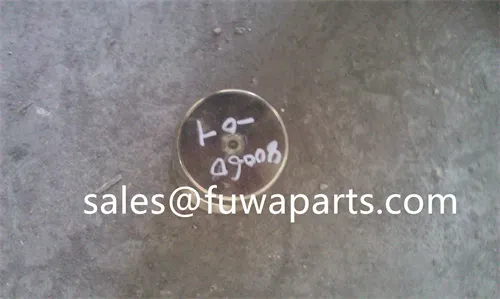
This is the lower jib pin axle for the SANY SCC1500C crawler crane, the pin that carries the jib's lower section at its hinge, so the jib can be pinned up, folded, carried and re-pinned on the next lift. It is a solid machined pin: a cylindrical body with a flanged end and a central bore, the shank turned true and the faces finished so it still slides cleanly after months in a yard. A reference is marked on the end face, which is how most crews identify the worn pin they are holding.
Alloy steel pins at different joints look alike but do not swap. Lattice crane boom parts are built around a specific pin diameter, grip length and collar position, and a pin that is even slightly off will either refuse to pass through the lug or sit loose and wear the bore oval. This one is the pin for the lower jib joint; the main boom and the jib head use their own pins with their own codes, and we supply them as separate items.
It sits in our SANY crane spare parts range alongside link panels, foot sections, boom inserts and sheaves, so a jib repair can be ordered as one list instead of four separate enquiries. If you are working from the machine rather than from a parts book, send the number off the pin's end face and the machine model, and we will match it before anything is packed.
| Part number | 10110756 |
| Size code | XZ55×140 B4 |
| Position | Lower jib |
| Component type | Pin axle (hinge pin) |
| Form | Cylindrical body, flanged end, central bore |
| Material options | 35SiMn, 35SiMnMo, 28CrMnMo |
| Heat treatment | To OEM specification |
| Finish | Machined faces, protected against rust |
| Identification | Reference marked on the end face |
| Category | Crane boom parts |
| Supply route | Held as a stock item, or made to drawing |
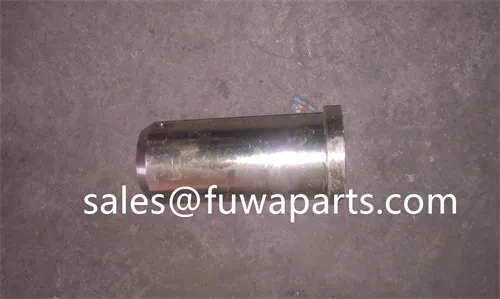
Pins in this family are produced in 35SiMn, 35SiMnMo and 28CrMnMo, manganese-alloy steels chosen for hardenability and toughness rather than for a low price per kilo. Heat treatment follows the OEM specification, so the shank comes out hard enough to resist scoring against the lug bore while the core stays tough enough to take a blow from a drift without cracking. Each alloy steel pin is turned and faced, the collar face is squared to the shank so it seats flat, and the finished part is coated against rust before packing. That coating is what keeps a pin usable after months in a container or a humid yard, so wipe it off before assembly, not before storage.
Material is the whole argument, because a pin is a low-cost component with an expensive failure. A soft pin deforms under load, burrs at the ends and has to be driven out; a pin that is too hard chips at the collar and leaves a sharp edge that cuts into the bore. Since a stuck pin can stop a whole machine, construction machinery spare parts like this one are judged on grade and fit far more than on unit price, and the useful question is which steel is actually in the box. If your maintenance plan calls for a particular grade, tell us when you enquire and we will confirm what is available for the quantity you need.
The number this pin is supplied under is 10110756, and it is the number to quote when you order. Numbers are rarely tidy in the field: pins get swapped between joints, superseded references sit on the shelf for years, and the marking on the end face may be stamped, paint-marked or written by hand rather than rolled on by a machine. Copy whatever is there exactly, including any prefix or suffix, and tell us where it came from, because a number taken from a parts book and a number read off the part can lead to different answers.
If no number survives at all, you are not stuck. Send the old pin, or a sketch with the key dimensions marked, and we will quote you a pin made to drawing in the same alloy steels used for the standard parts. That route takes longer than a stock order, and heavy equipment spare parts ordered that way rarely arrive in the week you first think of them, so start it before the joint reaches the critical path.
For construction machinery spare parts in general, and for pins in particular, the code on the part is worth more than a photograph. Two pins can feel identical in the hand and differ by a millimetre at the collar, so send the code and the measurements together and let our engineers settle it.
Machines do not stop ageing when a model leaves production, and a lower jib pin stays in demand long after the crane has moved to its second or third owner. We supply SANY crane parts for machines well past their first overhaul: the same pin and the same joint, taken from stock where it exists and made to drawing where it does not. Send the model, the serial number and a photo of the nameplate, and we will tell you plainly what can be done, including for older units that no longer appear in current parts books.
The pin is rarely the only thing on the list. Most orders that start at a joint end up including seals, a sheave, hose or a service set, and we hold SANY filters and other consumables alongside the structural parts so a maintenance list can ship as one consignment with one set of export documents.
Beyond this machine we handle ZOOMLION, XCMG and FUWA crawler crane parts as well as rotary drilling rigs, and structural work is where we are strongest: boom sections, link panels, foot sections, pins, sheaves and the fittings around them. If you are rebuilding a lattice boom after an incident, send the drawing or the damaged part and we will quote the pieces you actually need instead of a whole assembly.
Not sure which part fits your machine? Send the part number, the machine model, and a photo of the nameplate or the worn item, and our engineers — each with more than ten years in the construction machinery business — will confirm the correct reference and quote it. We advise on installation, help trace faults, and answer technical questions before and after dispatch. Since 2017 we have built this support on a supplier network covering FUWA, SANY, XCMG and ZOOMLION, so older and hard-to-find crane spare parts can usually still be sourced.
Send the machine model, the serial number, the number from the old pin's end face and a photo of the lug, and our engineers will check the joint against our SANY crane parts records before we quote. Pins are matched by joint and by size code rather than by model alone, so the more of that you can supply, the faster the confirmation comes back. If the original number has been superseded, we will tell you what replaced it.
New. Every pin we ship is a new construction machinery spare part, not a refurbished or used take-off, and it is checked for the machined shank, the collar face and the bore before it is packed. That matters at a hinge joint, where a used pin usually arrives with the wear that made someone else remove it.
It is the size reference for this particular pin, the code that separates it from the other pins used on the same crane. Main boom pins and jib head pins carry their own codes and do not interchange, even when they look close enough to try. Quote this code together with the part number when you enquire; if the code on your old pin is different, send us what you have rather than ordering a near match.
Look for a scored or ridged shank, a step worn into the shank where it meets the collar, pitting that stays after wiping, or a burred and flattened end from repeated extraction. Fit is the other half of the answer: if the joint goes tight, or a new pin will not slide in by hand, the bore may already be oval and a pin alone will not restore it. Judging a crane spare part on condition rather than on hours is the normal practice at this joint, because how often the jib is pinned up and how the machine is stored matter more than the calendar.
Yes. SANY filters, seal kits, hydraulic and electrical components, undercarriage parts and structural items are all part of what we supply, so a maintenance list can be quoted as one order and shipped together. Send the numbers you already have and we will fill in the gaps.
Yes, where we can work from a sample or a drawing. Send the worn pin, or a sketch marked with the shank diameter, overall length, collar thickness and bore size, and we will quote against it in the same alloy steels used for the standard parts. Made-to-drawing pins take longer than a stock item, so raise it as soon as the joint starts to wear rather than after it fails.


