



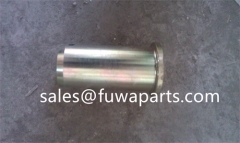
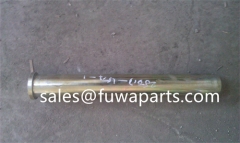
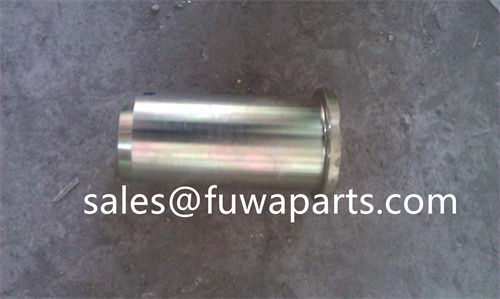

Every lattice boom joint on a SANY SCC1500C turns on a pin, and this is the one specified for the basic main boom connection. Part number 10110752, size XZ60×125_D6: a straight-through pin with a flanged head, a transverse retaining pin and a machined shank that passes through the boom lug eyes.
The pin carries the shear load that passes between the boom sections when they are joined, so it is a wear item rather than a permanent fitting. When a pin frets in the lug or takes a step where the eyes bear on it, the joint stops drawing tight and the sections start working against each other — which is where a boom pin replacement usually begins. A new pin puts a clean bearing surface back into the joint, and in most cases the boom sections themselves go straight back into service.
We supply sany crane parts like this one to fleets, contractors and repair workshops that already know the reference they need and want it confirmed quickly. Every pin ships new — nothing refurbished, nothing pulled from a dismantled machine.
Working across construction machinery spare parts for SANY, ZOOMLION, XCMG and FUWA equipment teaches you to ask three things first: which joint, which code, which machine. Matching crane spare parts by reference rather than by resemblance is the whole job — send those three and the pin is confirmed against your crane, not against a photograph of something similar.
| Part number | 10110752 |
| Size code | XZ60×125_D6 |
| Machine model | SANY SCC1500C crawler crane |
| Boom position | Basic main boom joint |
| Part type | Pin axle |
| Material | 35SiMn / 35SiMnMo / 28CrMnMo alloy steel |
| Heat treatment | Heat treated to OEM specification |
| Condition | 100% new, not refurbished or used |
| Finish | Machined, smooth metallic surface |
| Retention | Flanged head with transverse retaining pin |
The pin is machined from one of three alloy steels — 35SiMn, 35SiMnMo or 28CrMnMo — grades chosen because a main boom pin works in shear and bearing rather than in tension, and they hold their surface hardness under repeated load. Each is heat treated to OEM specification before final machining, so the finished pin keeps its dimensions through the working cycle instead of deforming at the bearing area.
That balance matters more than it sounds. A pin that is too soft develops a flat or a step where it bears on the lug eyes, and once that step forms the joint will not draw tight however carefully it is shimmed. Push the hardness the other way and the risk moves to the change of section behind the head, where a brittle pin can crack. Heat treatment to the original specification is how those two failure modes are held apart.
The photographs show the finish you will unpack: a smooth, reflective machined shank, a clean flanged head and no casting skin anywhere on the bearing surface. Surfaces like that seat predictably against the lug and give a clear reading when you check the pin for wear later on.
Because the pin is machined to the reference carried on the original drawing for these construction machinery spare parts, the fit at the joint is set by the code rather than by a nominal size. If your crane runs a modified boom, send the drawing and the pin can be worked to that instead.

A joint repair rarely stops at the pin. We supply the full run of crane boom parts — boom head, boom insert sections, boom foot, link panels, sheaves and wire rope — so a repair that starts with one pin does not stall waiting for the next item.
Below the deck the same stock covers crawler crane parts: track shoes, track rollers, idlers, drive sprockets and tension devices for SANY, ZOOMLION, XCMG and FUWA machines.
On the service side we carry filters, seal kits and repair kits, including sany filters — oil, fuel, air and water separator elements for SANY engine and fuel systems.
Beyond those groups, construction machinery spare parts such as hydraulic pumps, motors and valves, controllers, monitors and sensors can be quoted against your machine model. Send the model and the group you need and we will tell you what is on the shelf.
Not sure which part fits your machine? Send the part number, the machine model, and a photo of the nameplate or the worn item, and our engineers — each with more than ten years in the construction machinery business — will confirm the correct reference and quote it. We advise on installation, help trace faults, and answer technical questions before and after dispatch. Since 2017 we have built this support on a supplier network covering FUWA, SANY, XCMG and ZOOMLION, so older and hard-to-find references can usually still be sourced.
Yes. Older SCC1500C machines and references that have dropped off the current list are the normal end of this work. Send the machine model, the serial number if you have it, and a photo or drawing of the part: where the reference is still current it is supplied from stock, and where it has been discontinued we work from the drawing or from the old part itself. The same applies to the older sany crane parts in our range, where the number on the machine is often the only record left.
Start with what is on the part you are removing — here the size code XZ60×125_D6 — together with the machine brand, model and serial number. A photo of the markings is ideal; if they are worn, send a caliper reading of the shank diameter, the overall length and the retaining-pin hole position. We check those against the reference for the SCC1500C main boom joint and confirm in writing before the pin is packed, so you have the match on file. It is the same check we run on any SANY crane parts enquiry.
The pin is the item offered here, with its flanged head and transverse retaining pin, which is what the photographs show most clearly. Some of the images also show the flanged sleeve that seats in the joint. If your sleeve is worn as well — and a worn sleeve will shorten the life of a new pin — tell us which joint you are rebuilding and we will confirm the matching sleeve alongside the pin.
It is specified for the SCC1500C basic main boom joint. Other SANY models, and the jib and link-panel positions on the same machine, use different pin references and different sizes, so a pin from one joint should never be assumed to fit another. Send the model and the joint position and we will confirm before you commit.


