





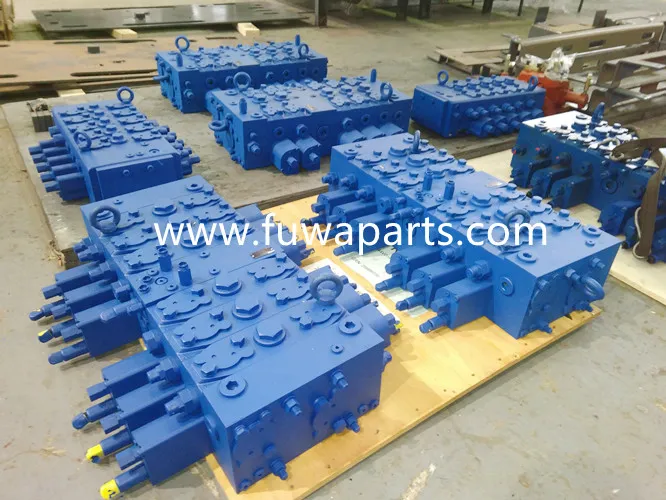
The M4 and M7 families are Rexroth sectional directional control valves: the block that takes oil from the pumps and sends it, section by section, to the hoist, boom, travel and outrigger circuits of a crane. We supply both families for FUWA crawler cranes, SANY rotary drilling rigs and ZOOMLION and XCMG machines, and every unit is new — no rebuilt bodies, no re-sealed returns.
Most buyers arrive here with a valve that has started to bypass, stick in one direction or weep at an end cap, and what they need is the exact reference rather than something close. The blocks ship with the details you can see in the photos: a blue-painted cast body, threaded plugs screwed into the ports, cartridge valves set down into the block and red caps over the spool ends. Those caps and plugs stay on until the hoses go on.
Treat the number as the identity of the part. In a crane spare parts system it is the reference, not the machine model, that pulls the right valve off the shelf, and it is the reference that decides whether the block bolts straight on or comes back. Because these are hydraulic crane parts shared across four major Chinese builders, one reference can serve a mixed fleet — which is why this product is organised by number rather than by badge.
| Parameter | Detail |
|---|---|
| Series | Rexroth M4 and M7 |
| Valve type | Sectional directional control valve |
| Maximum pressure | 450 bar |
| Nominal pressure | 400 bar |
| Condition | 100% new, not refurbished |
| Origin | Made in Germany |
| Machine fitment | FUWA, SANY, ZOOMLION and XCMG cranes and drilling rigs |
| Valve body | Cast sectional block, blue painted |
| Ports | Threaded, plugged for transport |
Each valve is a stack of machined sections bolted into one cast body and finished in blue paint. What decides whether it seals is not the paint but the detail underneath: flat machined faces where the sections meet, threaded ports with plugs screwed in, cartridge valves set down into the block, and bare spool rods protected by red caps.
Those plugs and caps are working protection, not packaging to be thrown away on arrival. Grit or moisture that reaches a gallery during storage will score a spool the first time the machine runs, and a single metal shaving left in a port can hold a section open. Leave everything in place until the moment a hose is ready to go on.
A hydraulic valve is one of those crane spare parts that fails quietly. Flow drops, one function slows, the operator compensates without mentioning it, and the fault is only noticed weeks later when the machine will not hold a load. Keeping the machined faces clean and unmarked during fitting is what protects the performance you paid for.
The blue paint is a corrosion barrier for machines that work in dust and rain, not a cosmetic finish. On arrival, look at the machined faces and the port threads rather than the body: a rolled thread or a scratch across a sealing face is what will cause trouble later, and it is worth photographing before the valve goes anywhere near the machine.
Two valves can look alike on the outside and still not interchange, so a few checks on the machine prevent a return freight bill. Begin with the number stamped or cast on the valve body: that fixes the family and the section arrangement. Then count the sections and photograph the hose layout with the lines still connected, because the port positions on each section have to line up with the way the hoses run.
Coils need their own check. A coil body carries markings for voltage and connector type, and a valve fitted with the wrong coil will bolt up neatly and then refuse to shift. Note whether each section carries one coil or two, and whether the connectors are the same across the whole bank.
Describe the symptom in plain terms as well — a function that creeps, a spool that sticks one way, oil weeping past an end cap, or a coil that gets hot and drops out. Each points at a different part of the assembly, and a fault blamed on the block often turns out to be a coil, an O-ring or a relief setting elsewhere in the circuit.
If the machine carries a crane load indicator that reads from a test point on the block, write the reading down before the old valve comes off. Knowing what the machine showed while it was still working gives you a baseline to compare against once the new unit is in. Working with experienced crane spare parts suppliers saves a second freight bill: the wrong reference means the machine stands while a valve travels back and forth.
Every valve here is new. Nothing in this construction machinery spare parts line is a rebuilt unit, a re-sealed return or a take-off from a dismantled machine, and the blocks arrive with their original port plugs and spool caps in place.
Checks run at three points. The reference and the body are verified on receipt from the supplier, the assembly is inspected during preparation, and each unit is function-tested on a bench before it is packed and released with the paperwork that travels with the shipment. What the inspector looks for is simple and physical: a clean machined face, undamaged port threads, free spool movement and no corrosion creeping under the paint.
Consistency is the point of the routine. A workshop replacing the same section on three sister machines wants three valves that behave the same way, and matching by reference then testing each unit is what produces that. It also means a repeat order is not a gamble on a different batch.
If a valve arrives damaged or does not behave as it should, photograph it before fitting and tell us. Once a valve has been in a circuit, the evidence of what happened to it is much harder to read.
| Term | Detail |
| Minimum order | 1 piece |
| Payment | T/T; Western Union or as agreed |
| Lead time | Most parts in stock. Usually need 7-20 days, according to the quantity |
| Trade terms | EXW, FOB, CFR, CIF |
| Shipping | Shipped via Shanghai, Dalian, etc. |
| Warranty | 2500 working hours or one year |
| Warranty covers | Material and workmanship defects |
Not sure which part fits your machine? Send the part number, the machine model, and a photo of the nameplate or the worn item, and our engineers — each with more than ten years in the construction machinery business — will confirm the correct reference and quote it. We advise on installation, help trace faults, and answer technical questions before and after dispatch. Since 2017 we have built this support on a supplier network covering FUWA, SANY, XCMG and ZOOMLION, so older and hard-to-find references can usually still be sourced.
They are used on FUWA crawler cranes, SANY rotary drilling rigs, and ZOOMLION and XCMG cranes. The blocks are shared across models, so the crawler crane parts list for one machine often carries the same reference as another; that is why we match on the stamped number rather than on the model name. If you can read the number on the old valve, fitment is usually settled in one message.
Often, yes. The M4 and M7 blocks appear in mobile crane parts lists as well as on crawler machines, but a match on the family name alone is not enough — the section layout and port pattern have to line up. Send the reference and a photo of the hose layout and we will confirm before you commit to the order.
Yes. Coils, connectors and seal kits are separate items and are stocked alongside the valves. Give us the coil markings — voltage and connector type — because a coil that fits physically can still be wrong electrically, and a mismatch shows up as a hot coil or a function that will not shift. Monitors, controllers and the rest of the crane electrical components can go on the same order.
Keep it in its wrapping and on its side, in a dry place away from grinding, painting and sandblasting. Leave the port plugs and spool caps in place until each hose is ready to go on. Nothing damages hydraulic crane parts faster than an open port in a dusty workshop, and a valve that has sat on a shelf for months should still be checked for clean faces and free spool movement before it goes on the machine.
Usually. Worn numbers are common on construction machinery spare parts that have been in service for years, so send photographs of the body from a couple of angles, the section layout, and the machine model and serial number. Casting marks and the port pattern often narrow it to one reference. If two numbers remain possible, we will tell you what to measure to separate them — that is the part of the job good crane parts suppliers get right the first time.
A straight swap of the same reference normally leaves the crane load indicator working as before. If the machine's limiter takes a pressure signal from a test point on the valve block, check the reading after commissioning and recalibrate only where the machine manufacturer's procedure calls for it. If the reading looks wrong, stop and check the circuit before the machine goes back to work.


