



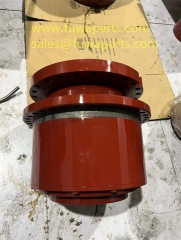
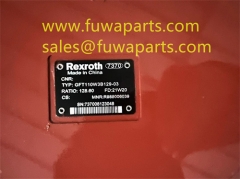
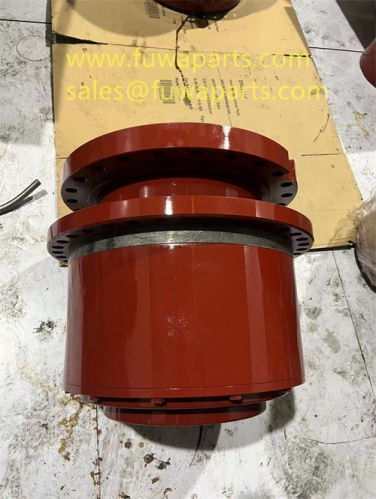

This Rexroth crane hoist gearbox is the planetary reducer driving the hoist on crawler cranes from SANY, XCMG, FUWA and ZOOMLION, and it is the reference fitted to the FUWA QUY250 main and auxiliary winch. It sits between the hydraulic motor and the winch drum, turning motor speed into the torque a hoist needs to lift, hold and lower a load, and it bolts to the winch frame on flanged mounting ends with a machined centre band and a red-painted housing. Units arrive new, with the Rexroth identification plate intact. That plate carries the type code, the ratio, the MNR and the serial number, and it matters more than the badge on the crane: the same GFT family is used by four manufacturers across several machine sizes, and it is the ratio and the input coupling that decide fit before the model name does. Workshops tend to reach for this reference when a winch starts to whine under load, when the drum will not hold, or when an oil sample comes back with metal in it. We have been supplying construction machinery spare parts from Shenyang since 2017 to repair shops, fleet maintenance teams and parts traders, and the questions we ask before anything ships are the same ones a technician asks on site: which machine, which winch, which ratio, and what does the plate say.
| Product type | Planetary gear reducer |
| Series | GFT110 |
| Type designation | GFT110W3B129-03 |
| Ratio | 128.60 |
| FD marking | 21W20 |
| Material | Stainless steel |
| Condition | 100% new |
| Winch application | Crawler crane hoist drive |
| Compatible crane brands | SANY, XCMG, FUWA, ZOOMLION |
| Manufacturer | Rexroth |
| Manufacturer code | 7370 |
| Country of manufacture | China |


FUWA is one of China's major construction machinery companies. The group was set up in 1904 and has the longest history of any construction equipment manufacturer in the country, with a long record of contribution to the industry. FUWA builds machines to a standard its customers rely on, keeps developing new models on current technology, and has improved its management step by step to support the service it gives customers.
We supply FUWA crawler crane parts from China, with the response times a working machine needs. Close to ten years on this product line has built a reputation in more than 20 countries, with after-sales service stations in a number of them and crane engineers who can attend site when a repair goes beyond the workshop. Our FUWA crane parts catalogue covers the full range.
The crawler range is where most of that expertise sits, but the same organisation covers mobile crane parts for the truck cranes in a mixed fleet.
Structure, undercarriage, hydraulic and electrical groups are all supplied for these machines, and the wider construction machinery spare parts list is handled on the same order.
Crane electrical components — cables, monitors, controllers and sensors — sit alongside the mechanical side, so a machine can be brought back to specification without splitting the order three ways.
Load monitoring goes the same way: a crane load indicator is matched to the machine model and to the display already fitted, so the replacement reads the same as the one it replaces.
| Minimum order | 1 piece |
| Payment | T/T; Western Union or as agreed |
| Lead time | Most parts in stock; usually 7-20 days, according to the quantity |
| Trade terms | EXW, FOB, CFR, CIF |
| Port of loading | Shanghai, Dalian, etc. |
| Packing | Plywood box |
| Warranty | 2500 working hours or one year |
| Export documents | Commercial invoice and packing list |
| Shipping mode | Sea or air freight as arranged |
| Package marking | Export marks as arranged |

Not sure which part fits your machine? Send the part number, the machine model, and a photo of the nameplate or the worn item, and our engineers — each with more than ten years in the construction machinery business — will confirm the correct reference and quote it. We advise on installation, help trace faults, and answer technical questions before and after dispatch. Since 2017 we have built this support on a supplier network covering FUWA, SANY, XCMG and ZOOMLION, so older and hard-to-find references can usually still be sourced.
It is the hoist reducer for SANY, XCMG, FUWA and ZOOMLION crawler cranes. We supply mobile crane parts as well, so if the winch drive sits on a truck crane rather than a crawler, send the plate photograph and we will check it the same way.
New. Nothing is stripped, re-sealed and sold on, and your old reducer is not taken in exchange. The Rexroth plate stays intact with its type code, ratio, MNR and serial number so the part can be traced back.
Send photographs of the flange, the input shaft and the mounting area, plus the crane model and serial number. With those three views we can usually identify the correct reference from our crane spare parts range even when the plate is worn past reading.
We also handle Kawasaki and other Japanese planetary reducers for these cranes, so a mixed fleet is not a problem. If your machine runs a different make, send the plate from the old unit and we will compare ratio, flange and input coupling — the three points that decide whether a hydraulic crane part will seat on the same frame.
Use the grade and fill level the manufacturer specifies for the crane hoist gearbox; that information sits in the machine manual rather than on the reducer plate. If the manual has gone missing, tell us the crane model and we will help you confirm the specification before commissioning.
Fit is set by the flange, the input coupling and the ratio, not by the model name. Send the plate and flange photographs and we will check whether another unit in the GFT or GFB range matches those three points. Good crane parts suppliers tell you plainly when nothing in the range will fit, and we will do the same.


