




Counterweights are what let a crane use its load chart. Mounted behind the slewing centre, the blocks balance the load moment so the machine stays stable through slewing, travel and pick-and-carry work. As crane parts suppliers, we supply cast gray iron counterweights for FUWA crawler cranes, XCMG mobile cranes, and SANY and ZOOMLION cranes, as individual blocks or as the sections of a stacked ballast set.
Most orders start with a repair rather than a new build: a block that cracked when it was set down too hard, one that corroded through years of coastal storage, or a section that went missing when a crane moved between yards. The iron is cast from a pattern instead of being welded up from plate, so the replacement can follow the original outline — the thickness, the seat and the lifting points stay where the machine expects them.
Counterweights are one line in the crane spare parts we keep for these four brands. Crawler crane parts such as track shoes, rollers and idlers sit alongside, and a mobile crane parts line runs with them — wire rope, sheaves, pins — so a job that grows from one block into seals and hoses can stay on a single order.
Where no original reference survives, we work from a drawing. Send the block outline, the mounting positions and the weight you need, and the counterweight is cast and finished to that specification — the route contractors take for older machines, for re-rated cranes where the crane load indicator has to be checked, and for yards where several brands share one set of ballast.
| Machine / application | What we supply |
| FUWA crawler cranes | Counterweight blocks matched to the model plate or to the casting number on the old block |
| XCMG mobile cranes | Mobile crane parts and counterweights, including a single damaged section from a stacked set |
| SANY cranes | Cast gray iron counterweight sections for SANY crawler and mobile machines |
| ZOOMLION cranes | Replacement blocks for current and older ZOOMLION models, using drawing-based casting where no reference survives |
| Mixed-brand fleets | As crane parts suppliers, we identify blocks from photographs, measurements and cast marks when the model is uncertain |
| Older machines | Counterweights recreated from a sample block or a works drawing when the original is no longer listed |
| Other heavy machinery | Counterweights for construction equipment outside the four crane brands, quoted from drawing, with construction machinery spare parts on the same enquiry |
| Property | Detail |
|---|---|
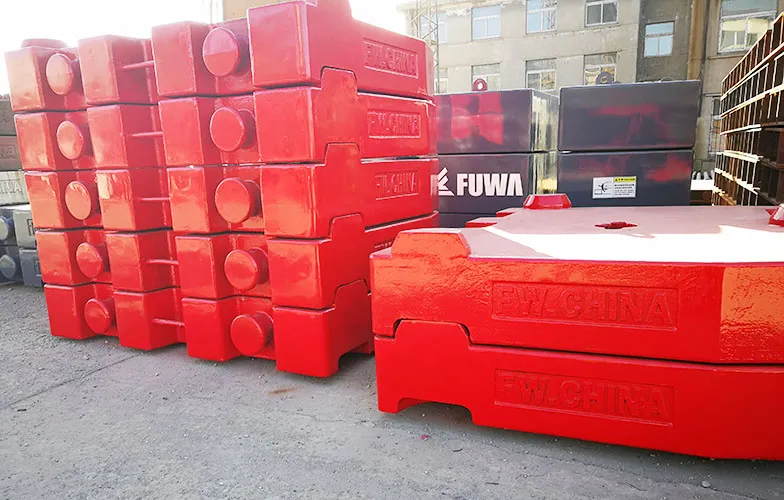
| Material | Gray iron counterweight castings |
| Production route | Cast from a pattern, then finished and painted — the same route as other crane spare parts |
| Form | Single counterweight blocks, or individual sections of a stacked counterweight set |
| Lifting points | Cast-in lugs |
| Marking | Cast identification numbers and brand marks |
| Machine brands | FUWA, SANY, ZOOMLION, XCMG — we are crane parts suppliers for these models |
| Machine types | Crawler cranes and mobile cranes |
| Custom sizes | Cast to drawing, sample block or site measurement |
| Weight and dimensions | Taken from the original block or your drawing, and confirmed on the quotation |
Every counterweight we ship is new — no used or reconditioned blocks, and no sections reclaimed from a scrapped machine. Castings are checked before dispatch: the block is measured against the drawing or the sample it was matched to, the seat and lug faces are inspected for cracks and blowholes, and the paint is checked on the faces that will sit against the tray.
If your own quality file needs evidence, ask for photographs and dimensions at the pre-dispatch stage. We can put a tape on the block and send the readings with the pictures, which is faster than discovering a problem after the crate has crossed an ocean.
Packing follows normal practice for heavy castings. Blocks are braced inside a timber or plywood crate, blocked so they cannot shift in transit, and marked with the weight and the lifting points so the receiving yard can handle them without opening the case. If the destination has a lifting limit, or the blocks have to arrive on a particular pallet footprint, tell us and the packing is built around it.
A mixed order runs through the same inspection, which is how we handle construction machinery spare parts generally — one check pass across the consignment rather than one per line item.
Not sure which part fits your machine? Send the part number, the machine model, and a photo of the nameplate or the worn item, and our engineers — each with more than ten years in the construction machinery business — will confirm the correct reference and quote it. We advise on installation, help trace faults, and answer technical questions before and after dispatch. Since 2017 we have built this support on a supplier network covering FUWA, SANY, XCMG and ZOOMLION, so older and hard-to-find references can usually still be sourced.
Send the brand, model and serial number, a photograph of the block in place, and the casting number from the old block if it is still readable. The measurements that settle it are the seat width, the height under the tray, the hole or pin pattern and the overall outline. Our engineers compare those against the drawing and confirm before anything is quoted.
Yes. Older machines are often the easier cases, because the block itself is the reference — we measure the sample, read the casting marks and produce a replacement to match. Where the block is missing altogether, a works drawing or the counterweight chart from the machine's manual gives us what we need to recreate it.
Each block has cast-in lugs or eyes, and that is the pick point — a sling passed around the body can slip as the block swings. Use rated slings and a spreader where the lugs sit close together, and check the lugs for cracks or wear before a lift, especially on a block that has stood in the yard for years.
Start at the lugs and the seat faces. Cracks usually begin at a lug or a corner, wear shows on the face that sits against the tray, and corrosion builds where water stands between stacked blocks. Check the retaining pins and bolts at the same time, and photograph any casting number you can see, because that is what identifies the replacement if one is needed.
Often yes — the blocks in a stack are separate castings, so if the position and the block's marks can be identified, one section can be supplied without the rest of the set. Send a photograph of the stack, note which block is damaged, and we will confirm against the drawing or the cast number before quoting.
A like-for-like block in the same position keeps the machine's configuration unchanged. If the ballast arrangement itself changes — a different number of sections, or blocks brought in from another machine — the load indicator and the chart should be checked and, where the system allows, re-set by a qualified technician before the crane returns to work.


