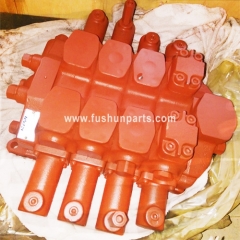
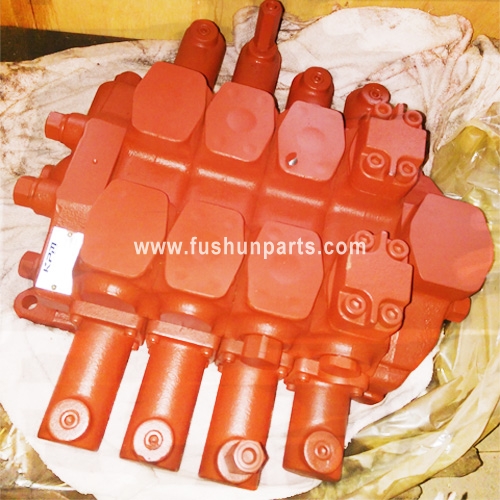
Product Overview
The multiport valve is where the QUY80's hydraulic system divides. Pump flow arrives at this block and leaves it in metered streams for the boom hoist, the winch drums, swing and travel, so the condition of the valve decides how precisely the machine places a load. A worn unit seldom fails without warning — functions drift, combined operations go vague, and a circuit starts creeping when the lever returns to centre.
On an 80-tonne crawler crane that is already a production problem. The machine is usually on a bridge deck, a port quay or a mining bench, where every hour of downtime is measured against the cost of the lift, and a control block is not something that can be patched on site. This replacement is a complete new unit, built in Japan and rated for the pressures the QUY80's main pumps produce.
It is also the kind of crane spare parts item that is either on your shelf or three weeks away. Most of the machines we support work seven days a week, so the sensible move at the first symptoms is to order early and fit the valve during the next planned service, rather than wait for a failure that takes the crane off the job entirely.
The number on the body is what identifies the valve, so it is checked against your machine details before the unit is packed. It is a small step, but it is what separates construction machinery spare parts suppliers who get a machine running again from the ones who only get a parcel delivered.
Valve Function on the QUY80
- One section per crane motion. The body is built from several bolted spool sections rather than a single monoblock casting, and each section serves a different circuit — boom hoist, main winch, auxiliary winch, swing and travel.
- Proportional, not just on and off. Each spool feathers flow as the lever travels, which is what lets an operator inch a load off the ground or bring a boom over slowly instead of snatching it.
- Pressure control inside the block. Relief and pressure-limiting elements sit in the same body, so a function stalled against a load is protected at the valve rather than back at the pump.
- Combined operations feel it first. Lifting while swinging, or travelling with the boom raised, is where a tired valve announces itself — the two functions stop sharing flow evenly long before either one fails outright.
- Ports that keep the deck clear. The hose ports sit on the underside of the body and take the runs down and away, leaving the top of the block accessible for spool ends and adjusters.
- The motions the safety system watches. Boom angle, winch rotation and travel are the same movements a crane load indicator depends on, so a spool that creeps or sticks can surface as an unstable reading before anyone condemns the valve.
- Feel is the giveaway. Operators judge a crane by how it responds, and among hydraulic crane parts the control block is the one that decides whether a lift feels precise or vague.
Specifications
| Component |
Multiport (main directional control) valve |
| Maximum working pressure |
420 bar |
| Origin |
Made in Japan |
| Body material |
35SiMn, 35SiMnMo or 28CrMnMo |
| Construction |
Sectional body with bolted spool sections |
| Spool sections |
One per controlled crane motion |
| Port layout |
Lower-facing ports for hose runs |
| Condition |
100% new |
| Finish |
Painted body, machined sealing faces |
Material & Build
Material on crawler crane parts like this one is chosen for pressure fatigue, not for appearance. Valve bodies in the series are produced in 35SiMn, 35SiMnMo or 28CrMnMo — manganese-silicon steel, and the molybdenum- and chromium-bearing grades where the section is thicker and the body has to hold its shape through millions of pressure cycles. All three are common in Chinese-built hydraulic castings; if your maintenance record names a grade, tell us and we will confirm what is fitted to the unit reserved for you.
The work that decides whether a valve lasts happens after casting. Bores are machined and honed to size, cross-drillings are deburred, and spool clearance is held tight enough that oil cannot slip past a centred spool. Internal leakage is the failure mode that matters on hydraulic crane parts: invisible from outside, it shows up as heat, drift and slow functions long before a drop appears on the floor.
Assembly is done clean, and the ports are capped for shipping. Grit left in a passageway will find the spool the first time the machine works, which is why the unit should not be opened on site and why the caps stay on until the hose is ready to go back. The body is painted on the outside, with sealing faces and port threads left bare.
Machine Coverage & Valve References
| 35 t – 70 t |
QUY35, QUY50, QUY70 |
| 80 t – 120 t |
QUY80, QUY90, QUY100, QUY120 |
| 150 t – 320 t |
QUY150, QUY250, QUY320 |
| 400 t – 750 t |
QUY400, QUY500, QUY650, QUY750 |
| 1,250 t |
QUY1250 |
| Balance valve references |
KDC30MR-A3.1/235-752A, KDC30MR-A3.1/245-773, KDC30MR-3.1/250-773, KDC30MR-A3.1/270-769, KDC30MR-A3.1/305-773, KDC30MR-A3.1/320-773, KDC30MR-A3.1/350-769, KDC30MR-A3.1/350-773, KDC30MR-A3.1/350-778 |
| Multiport valve references |
MWP425SCST767B, MWP4253ST7268B, MW125P5199, KMC10-2056, MWP4253ST7274, MWP3253ST7189, MW125P5205, MWP4253ST5262, MWP4253ST5263, MW125P5204, KMC10-6003, MWP5252S2CT710 |
Balance Valve or Multiport Valve
- Different jobs. The multiport valve decides where pump flow goes; a balance valve sits at the motor or cylinder it protects and holds the load when the lever returns to centre, so the load does not run away on its own.
- Different symptoms. A load that creeps or drops after the lever is centred points at a balance valve. A function that is slow, vague or will not hold while the lever is held points at the multiport block.
- Different bodies, different numbers. The two are never interchangeable, and the reference lists only look similar because both families are quoted in the same crane spare parts catalogues.
- The same split on mobile crane parts. Machines with a different control block still separate these two duties, so match the number and the mounting position rather than the outline of the casting.
- When the fault is unclear, check both. Drift and vague functions often arrive in the same service interval on a high-hour machine, so it is worth inspecting the balance valve on the affected circuit before the new block goes on.
- How to settle it quickly. Note where the valve sits — in the main control bank or out at the actuator — and the number on the body will usually confirm which family you are dealing with.
Replacement Sequence
- Confirm the reference against the old unit before anything is loosened. On most QUY80s the number is stamped or on a plate on the valve body; if it has been painted over, wipe the face rather than scraping it.
- Isolate the machine and release pressure. Shut down, lock out, and bleed stored pressure from the circuits before a hose is cracked — hot oil at working pressure is the main hazard on this job.
- Label every hose before removal. Photograph the port face with the hoses still on, then tag each hose to its port; the sections on the new body follow the same order, but a mis-connected return line makes the first test confusing.
- Cap the open ports and hoses immediately. Grit is the enemy of a new spool, and a particle in the wrong passageway can score a bore on the first lift.
- Look at what comes off with the old unit. Check the seals, the mounting face and the oil that drains out — metal in the oil is a reason to inspect the pump and the filters before the new valve goes on.
- Fit with new seals. Clean the mounting face, use fresh O-rings or gaskets, and tighten in sequence so the body seats flat instead of being pulled down on one corner.
- If the valve carries solenoid coils, check the crane electrical components that drive them before powering up. A coil with a damaged plug will make a healthy valve look faulty on the first test.
- Fill, bleed and test at no load. Run each function through its full stroke with the machine unloaded, watch for leaks at every joint, then load up and confirm there is no drift and that the crane load indicator reads steadily through the lift.
- Record the reference and the hours. The next crawler crane parts order for this machine then becomes a straight match instead of a search.
Ordering & Delivery
- Minimum order. One piece. A single valve for a machine that is down is the normal way this part is bought.
- Lead time. Most parts in stock; usually 7–20 days, according to the quantity and the stock position when the order is placed.
- Payment. T/T; Western Union or as agreed.
- Trade terms. EXW, FOB, CFR, CIF.
- Port of loading. Shanghai, Dalian, etc.
- Packing. Plywood box, export-crated for a sea leg, with the case number and destination port marked on the outside.
- Warranty. 2,500 working hours or one year.
- What to send with the order. The machine model and the reference from the old valve; if the number has been painted over, a photograph of the body and the port face is enough to start. That is what lets the unit be checked before it is packed rather than after it lands.
- Consolidation. If the same machine also needs filters, seals or other crane electrical components, say so when you order and everything can travel in one shipment.
- Mixed fleets. Buyers running crawler and mobile crane parts for the same project often combine them into one shipment to save a freight leg; send the machine list and the crate will be packed accordingly.
- Comparing quotes. Prices from different crane parts suppliers usually look similar on paper; what changes the outcome is whether the valve is checked against the machine and how quickly the crate moves. Confirm current terms and availability with your sales contact when the machine is down and every day counts.
About FUWA
FUWA Group traces its history to 1904 and is the longest-established construction equipment manufacturer in China. That matters when you are buying parts: a company that has been building crawler cranes for more than a century has kept model designations and hydraulic layouts stable enough that a QUY80 from one decade can share service parts with a machine from the next.
The company has kept developing new models and updating its production, and the QUY crawler line has stayed in production long enough that construction machinery spare parts support for an older machine remains a practical request rather than a theoretical one.
We have supplied FUWA crawler crane parts from China for close to ten years, with customers in more than 20 countries and after-sales support points in several of them. The QUY machines we support work in mining, bridge, port and oilfield applications, and the parts side of the business is organised around getting a crane back into service rather than around catalogue volume.
Repair and Replacement
- Start with the section, not the whole block. The body is bolted together from individual spool sections, so a fault on one circuit can often be cleared by lifting out that section alone while the rest of the valve and its pipework stay on the machine.
- Seal-level faults are the cheapest to fix. Weeping at a joint, a hardened O-ring or a seeping end cover is worth opening up; note exactly where the oil appears before you clean anything, because a leak at the top of the block often started lower down.
- Some damage cannot be recovered. A worn bore, a scored spool or a fretted mounting face stays worn no matter how many seals go in, and resealing a body with internal leakage only postpones the next breakdown by a few months. Metal in the oil that drains out is the signal to stop repairing and plan replacement.
- Compare both paths honestly. Add the section, the seal kit, the workshop hours and the days the crane stands still, then set that against a complete new block that goes on in a single shift. On a machine earning on a bridge deck or a port quay, the lost working days usually outweigh the difference in part price.
- Repair makes sense in specific cases. One function misbehaving on a machine with low hours, clean oil and no debris is a genuine repair job — the block itself is sound and the section is the whole problem.
- Replacement wins on the rest. Drift on two or more functions, a valve that has already been resealed once, or a site with no way to bench-test flow and pressure afterwards: any one of those supports a new unit, because a block that cannot be tested cannot be signed off for lifting.
- Keep the old block as a spare. If the crane has a planned shutdown, fit the new valve and send the old one for section work at leisure; a checked spare on the shelf is worth more than a repair that has to be finished in the rain with the machine blocking the access road.
- Tell us the symptom circuit by circuit. Which motion drifts, whether it happens cold or hot, and a photograph of the number and port face are enough for our engineers to say whether this hydraulic crane parts item can be saved or should be swapped — and ask what cover applies to a repaired section before the work starts, since the new unit carries 2,500 working hours or one year.
Technical Support & Model Matching
Not sure which part matches your machine? Send us the model, serial number and the original part number — or a photo and key dimensions — and our engineers will confirm the correct item and check availability before you commit. They have spent more than ten years in construction machinery and can talk you through fault-finding, installation and commissioning by phone, email or video. We also trace parts for discontinued and legacy models. Support runs 24/7 from Shenyang, China, where we have been supplying buyers since 2017.
FAQ
How can I tell whether the valve is worn or the pump is failing?
A tired multiport valve usually misbehaves one circuit at a time: a single function drifts or responds slowly while the others still feel normal, and pressure holds until you ask the machine to hold a load. A pump on its way out tends to slow everything at once, heats the oil faster and changes note under load. Oil analysis and a look at the filter will usually settle it, and a crane load indicator that keeps flagging an overload on a smooth, steady lift is sometimes reacting to a sticky spool rather than to the load itself. Sorting that out before you buy saves the cost of a pump you did not need — the most common waste in any construction machinery spare parts budget.
Can the valve be repaired instead of replaced?
Part of it, yes. The body is sectional, so a single worn section can be lifted out and changed, which is useful when one circuit has failed and the rest of the crane spare parts on the machine are still sound. What cannot be recovered is a worn bore or a scored spool in the main body — resealing a valve with internal leakage only moves the problem a few months down the line. On a high-hour machine drifting on several functions, replacement is usually the quicker way back to work.
What oil cleanliness should I keep after fitting a new valve?
Follow the cleanliness class your crane's manual specifies, and change the filters at the same time as the valve — a new block with fine spool clearances is far less forgiving of dirty oil than the worn unit it replaced. If the old valve failed with debris, flush the circuit before the new one is run. It is the cheapest insurance there is on hydraulic crane parts, and the habit most often skipped when a machine is under pressure to return to work.
Does the valve arrive with its solenoid coils?
The valve is supplied as the assembled block. Coil and connector details differ between builds, so send the coil reference — or a photograph of the old coil — along with the machine details and it will be checked against the unit reserved for you. If the machine's original coils are healthy they usually transfer across, and if they are not, the crane electrical components can be supplied at the same time.
Does this valve fit FUWA mobile cranes as well?
The valve numbers here are built around the QUY crawler line, from the QUY35 to the QUY1250. Mobile crane parts use a different control block, so a valve from this list will not normally cross over; send the model and the number from the old unit and we will confirm whether a match exists.