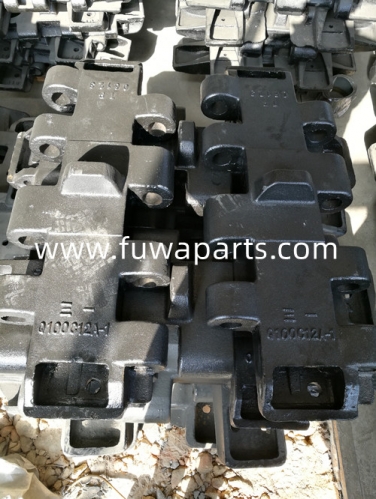
Product Overview
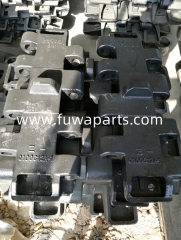
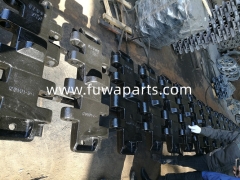
The track shoe is the only part of a crawler crane that touches the ground, and on the Hitachi Sumitomo SCX class it carries the working weight of the machine through every metre it travels — harder service than almost any other construction machinery spare parts see on the same machine. Each plate is a single cast steel shoe that bolts onto the track link: the raised grouser bar bites into the surface, the pad spreads the load, and the ribbed underside keeps the section stiff without adding dead weight to a part that has to be handled at change-out. Plates are supplied new, shot blasted and coated against rust, and they are made to the dimensions you specify rather than to one universal size — overall width, length, grouser height and bolt hole pattern all have to line up with your chain.
We supply these plates as individual crane spare parts, as a set for one chain, or as part of a mixed order alongside the pins, bushings and sprockets that wear with them. If a machine has been running on worn shoes, check the chain at the same time: a stretched chain wears a new set quickly, and planning both together is cheaper than coming back to it a season later.

Material & Build
- Three alloy grades for one pattern. Plates are cast in 35SiMn, 35SiMnMo or 28CrMnMo. All three are available for this shoe, and the choice is about your ground and duty cycle rather than the size of the machine — a distinction that matters on construction machinery spare parts, where the cheapest grade often costs the most over a full season.
- Heat-treated surfaces. The grouser and the running surface are heat treated so they resist abrasion while the body of the plate still absorbs impact from rock and debris instead of cracking through.
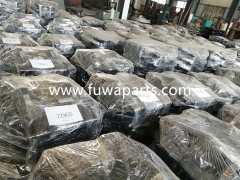
- Shot blasting before coating. Every casting is shot blasted, which cleans the surface and exposes any defect before the anti-rust coating goes on. It also gives the coating a key so it survives the sea leg and months in a yard.
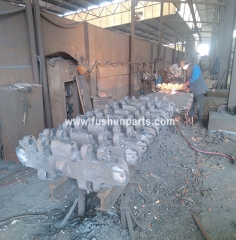
- A one-piece cast body. The grouser bar, the bolt bosses and the ribs underneath are cast as one piece. There is no weld seam along the grouser to open up under load.
- Machined bolt holes. Bolt holes are CNC machined so the shoe sits square on the link and the bolts pull up evenly. Oval or badly spaced holes are the usual reason a plate starts working loose on the chain.
- Ribbed underside. The recessed rib pattern under the plate stiffens it against bending on hard ground without making the shoe unnecessarily heavy to handle.
- Cast-in identification. Many plates carry a cast size or pattern mark, which is the quickest way to order the same shoe again later — worth knowing when one workshop keeps crawler crane parts for several models on the shelf.
- Rust protection as standard. The anti-rust coating goes on before packing, so plates that sit in a container or in the yard come out ready to fit rather than ready to clean.
Technical Specifications
| Parameter |
Details |
| Material options |
35SiMn / 35SiMnMo / 28CrMnMo |
| Surface treatment |
Shot blasting + anti-rust coating |
| Load capacity |
Customizable per OEM requirements |
| Applications |
Mining sites, port logistics, bridge engineering, oilfield operations |
| Condition |
100% new |
| Heat treatment |
Heat-treated surfaces for wear resistance and impact absorption |
| Bolt holes |
CNC-machined to align with the track link |
| Grouser profile |
Raised grouser bar with ribbed underside |
| Sizing |
Made to your required dimensions |
| Brand fitment |
Hitachi Sumitomo SCX, KH and CX classes; Sumitomo SC, LS and SD classes |
Model Coverage
- Hitachi Sumitomo SCX series. SCX300, SCX300-C, SCX400, SCX500, SCX700, SCX700-2, SCX800, SCX800-2, SCX900, SCX900-2, SCX1000, SCX1200, SCX1200-2, SCX1500, SCX1500-2, SCX2000, SCX2500, SCX2600, SCX2800-2 and 218HSL, plus closely related variants.
- Hitachi KH and CX classes. KH100, KH125, KH150, KH180, KH230, KH250, KH300, KH500, KH700, CX300, CX500, CX550, CX650, CX700, CX900, PD7 and PD100.
- Sumitomo SC, LS and SD. SC350, SC400, SC500, SC550, SC650, SC700, SC800, SC100, SC1500; LS13RH, LS78RM, LS78RH5, LS78RHD5, LS98, LS108RM, LS110C, LS118RH3, LS118RH5, LS120RH5, LS138H, LS138RH5, LS208H, LS218H, LS218RH5, LS238RH2, LS238RH3, LS238RH5, LS458HD, LS468HD, LS518 and LS528; SD205, SD307, SD407 and SD610.
- The wider crawler range. Beyond this pattern, crawler crane parts are stocked for FUWA QUY35 to QUY1250, SANY SCC500 to SCC16000, ZOOMLION QUY35 to QUY1250 and XCMG QUY 38–350 t, and cross-references also cover Hitachi, IHISCE and Kobelco track shoes.
- Control and safety items for the same machine. Sensors, monitors, controllers and limiters come from the same team, so crane electrical components can be added when a machine needs undercarriage and control work in one shutdown.
- Load moment and overload protection. That side of the range includes crane load indicator components for cranes coming in for an overhaul rather than for a single set of plates.
Applications & Site Conditions
Four kinds of site account for most of the plates we send out, and each one wears a track shoe differently.
Mining and quarry floors. Broken rock and haul-road grit are abrasive, and the grouser bar takes point loads for hours at a time. Heat-treated surfaces and the heavier alloy grades earn their keep here, and crane spare parts for a mine are usually ordered as a full set of plates because wear runs evenly along the chain.
Port logistics yards. Travel is long and the surface is flat concrete or paving, so the grouser bar wears down evenly and quickly. Machines travel at speed on that surface, which makes track tension and roller condition as important as the plate itself.
Bridge and infrastructure projects. Working platforms are often compacted fill or built-up hardcore, and the crane repositions constantly under load. What matters is predictable bite and even load spread across the pad, so the machine stays stable while it walks with a load on the hook.
Oilfield operations. Service cranes and pad-mounted rigs move between locations over unprepared ground and then stand idle between campaigns. Sound rust protection and a clean rib pattern matter when a machine sits for weeks before its next move.
Wear Signs & Replacement Timing
- Grouser height drops. Once the bar wears close to the pad face the shoe stops biting and starts slipping, especially on wet clay or loose fill. Loss of traction shows up long before a plate actually breaks.
- The pad face goes thin or dished. A dished pad no longer spreads load, so the link, pins and rollers take hammering they were never designed for.
- Cracks and chipped corners. Impact damage from rock is normal wear and tear; a crack running out of a bolt hole or across the rib pattern is a plate to take out of service.
- Bolt holes turn oval. Elongated holes let the shoe shift on the link, the bolts loosen and the chain starts knocking. Once a hole is oval, re-torquing will not hold it for long.
- Wear is uneven from one side to the other. If one chain wears much faster, look at track tension, sprocket condition and how the machine turns before blaming the plates — uneven wear is a machine problem rather than a fault in the construction machinery spare parts.
- The chain itself is stretched. Measure pitch before ordering any crane spare parts. New shoes on a worn chain wear quickly and never sit squarely on the link.
- Tension circuit faults. A slack or over-tight track, a tired recoil spring or weeping hydraulic crane parts in the tensioning circuit all shorten shoe life, and they are cheaper to put right at the same time as a set of plates.
Sizing & Pattern Details
- Start with the nameplate. Note the model and serial number from the machine plate. That fixes the SCX, KH, CX, LS or SD family and narrows the pattern before anything is measured.
- Measure the plate you are taking off. Overall width, overall length, grouser height, the distance between bolt hole centres, hole diameter and the number of holes. If only one side is worn, measure a plate from the other chain as a cross-check.
- Measure the link, not just the plate. Bolt hole spacing has to match the chain pitch. A plate that lines up with the holes but sits wrong on the link will work loose.
- Photograph it properly. Top, underside and side, with a tape measure in the frame. The underside tells us more than the top — the rib pattern and hole positions identify a pattern quickly.
- Look for a cast or stamped number. Plates often carry a size or pattern mark, and a label from an earlier order does the same job on a repeat buy.
- Send it over. This is where crane parts suppliers earn their keep: we check the measurements against our records, confirm the pattern and tell you what is available before you commit.
- Custom work. If the width, hole pattern or grouser profile is non-standard, send a drawing or a sample. Plates can be made to your dimensions rather than to a catalogue size, so mark hole spacing and hole diameter first.
Related Undercarriage Parts
- Drive sprockets. A hooked or worn sprocket wears new pins and bushings fast. If the teeth are visibly pointed, replace the sprocket with the chain work rather than after it.
- Idler pulleys and front idlers. They guide the chain into the sprocket, and a seized or badly worn idler puts side load on every shoe on the chain.
- Upper (carrier) rollers and lower (track) rollers. Rollers carry the load off the chain. Flat-spotted rollers hammer the links and shorten shoe life.
- Track pins, bushings and link assemblies. Pitch is the number that ties the whole undercarriage together, and it is the first thing to confirm when the chain is being rebuilt rather than patched.
- Tension components. Recoil springs and tension cylinders sit at the front of the same job, and the hydraulic crane parts in that circuit are worth checking while the machine is stripped down.
- Mobile crane parts. Fleets that also run QY truck cranes often order for both machine types at once, and those parts sit in the same range.
Ordering & Delivery
| Term |
Details |
| Minimum order |
1 Piece |
| Lead time |
Most parts in stock. Usually need 7-20 days, according to the quantity. |
| Payment |
T/T; Western Union or as agreed |
| Port of loading |
Shanghai, Dalian, etc. |
| Trade terms |
EXW, FOB, CFR, CIF |
| Packing |
Export plywood crate, plates shrink-wrapped and labelled in stacks |
| Warranty |
2500 Working Hours or One Year (whichever comes first) |
Technical Support & Model Matching
Not sure which part matches your machine? Send us the model, serial number and the original part number — or a photo and key dimensions — and our engineers will confirm the correct item and check availability before you commit. They have spent more than ten years in construction machinery and can talk you through fault-finding, installation and commissioning by phone, email or video. We also trace parts for discontinued and legacy models. Support runs 24/7 from Shenyang, China, where we have been supplying buyers since 2017.
FAQ
I only know the crane model — can you still match the plates?
Yes. Send the model and serial number from the nameplate together with photos of the old plate from the top, the underside and the side, and the key measurements: overall width and length, grouser height, bolt hole spacing, hole diameter and hole count. We match those against our records for the SCX, KH, CX, LS and SD families and confirm the pattern before anything is made or packed. A cast number on the plate, or a label from an earlier order, shortens the job considerably.
Which alloy grade should I order — 35SiMn, 35SiMnMo or 28CrMnMo?
All three are available for this shoe, and the right one depends on your ground and duty rather than on the size of the machine. Abrasive rock and constant travel are the conditions that justify the molybdenum grades; mixed ground and lighter duty are usually served well by 35SiMn. Tell us what the machine works on and how hard it is run and we will recommend a grade — most fleets pick one as their standard and keep the others for their hardest sites.
Can the plates be made to my own dimensions or from a drawing?
Yes. Sizes are made as you require, and for a non-standard width, hole pattern or grouser profile we work from a drawing or a physical sample. Mark the critical dimensions on the drawing — hole spacing and hole diameter first — and we will confirm what can be matched exactly and what needs a small adjustment. Custom patterns are preferably planned around a scheduled overhaul rather than an emergency breakdown.
Will the same plate fit other SCX models?
Not automatically. Width, hole spacing and link pitch change between models and between builds, so the pattern belongs to the machine and its chain rather than to the family as a whole. The same crawler crane parts range covers the other SCX, KH, CX, LS and SD models, so if you run several machines, list them all and each one gets matched separately.
Do you also supply the safety and control parts for these cranes?
Yes. The same team supplies crane electrical components — monitors, controllers, angle and load sensors and displays — and crane load indicator parts for load moment and overload systems. Items like these are matched from the machine model and the number on the old unit, in the same way as a track plate.
Are the plates new, and how long should a set last?
Every plate is new — 100% new, not reconditioned or repaired. Working life is decided on site by ground, travel distance, track tension and the state of the chain, sprocket and rollers, so watch the machine and replace as a full set where wear is even.