





Rock buckets and grab buckets are the working tools that hang off a crane or an excavator and meet the ground first. We build both families — a rock bucket for digging and loading, a grab bucket for rehandling material that has already been loosened — in sizes matched to the carrier rather than taken from a shelf.
Sizes follow the machine. We regularly build a 1.6 m³ grab bucket for KOBELCO units, a 2.15 m³ bucket for VOLVO machines and a 5 m³ bucket for HITACHI-class equipment. Treat those as examples from our construction machinery spare parts work rather than a fixed range: the volume that suits a machine depends on what it can lift at working radius and how heavy the material is, so each bucket is sized against the carrier it will serve.
Every bucket is built to a machine reference rather than guessed, which is what makes older carriers, one-off machines and mixed fleets workable. Where a drawing survives we build from it; where it does not, the bucket currently on the machine becomes the reference.
The duty is hard on steel, so the build has to suit the job — a bucket that is right for abrasive rock is not the same as one built for soft spoil. Tell us what you are loading and we will say what the wear package should look like.
If you already buy crane spare parts from us, tell us which machine the bucket is for and we will check it against the records we hold for you.
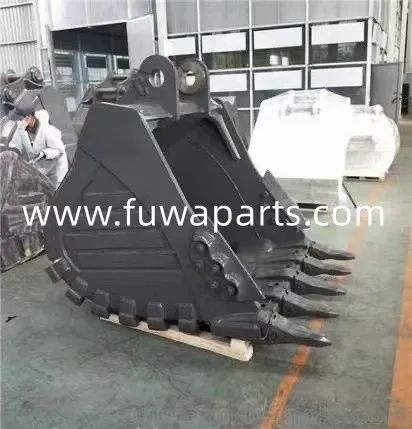
| Attribute | Detail |
| Body | Welded steel bucket body with side wear ribs |
| Cutting edge | Toothed digging edge |
| Mounting | Top mounting ears, pin connection |
| Material options | 35SiMn, 35SiMnMo, 28CrMnMo alloy steels |
| Heat treatment | Applied to meet OEM specifications |
| Finish | Painted steel |
| Inspection | Dimensions and welds checked against the agreed drawing |
| Condition | 100% new — no refurbished or used parts |
Orders start at one piece, so a single replacement for a machine that is standing is as straightforward as a fleet order. Payment is by T/T, Western Union or as agreed.
Most parts are in stock; delivery usually takes 7-20 days, according to the quantity and the specification. A bucket built to a drawing is scheduled with you before work starts. If a machine is down and you need the bucket quickly, tell us the date you need it and we will confirm what is achievable — priority shipping options such as air freight can be arranged for critical orders.
Volume pricing is available, so ask for a quote on the quantity you have in mind, whether that is several buckets or a mixed list. Adding the crane boom parts for the same machine to the order is routine. Putting a few hydraulic crane parts on the same list is just as normal, and it keeps everything on one set of documents.
We load from Shanghai, Dalian or another port that suits your route, and work on EXW, FOB, CFR or CIF terms. Buckets are palletised and blocked for container or flat-rack loading; tell us the destination and we will confirm the packing that fits.
Warranty is 2500 working hours or one year, whichever comes first. As crane parts suppliers we have been supplying fleets, contractors, workshops and resellers since 2017, and the same terms apply whether you are buying a single bucket or a project list.
Not sure which part matches your machine? Send us the model, serial number and the original part number — or a photo and key dimensions — and our engineers will confirm the correct item and check availability before you commit. They have spent more than ten years in construction machinery and can talk you through fault-finding, installation and commissioning by phone, email or video. We also trace parts for discontinued and legacy models. Support runs 24/7 from Shenyang, China, where we have been supplying buyers since 2017.
Older machines are a large part of what we handle. Send the model, the serial number or a clear photograph of the part, and we will match it from what we have built before or produce a replacement to your drawing. Where a machine has been out of production for years and no drawing survives, the part itself becomes the reference — measurements and photographs are enough to start. The same route covers crane spare parts and heavy equipment spare parts for mixed fleets where several vintages sit in the same yard.
Give us the crane's brand, model and serial number, then the three measurements from the old bucket: pin diameter, ear spacing and hole centres. Our engineers check those against the buckets we have built for the same machine class and confirm the specification in writing before you commit. Photographs of the bucket mounted on the linkage help more than most people expect, especially where the linkage has been repaired or modified. If the machine also needs crawler crane parts, put them on the same list so everything is checked once — it is the same process for a used crawler crane that has just joined the fleet.
No — one shell cannot serve both mountings, and a bucket built for one carrier will not work safely on the other. An excavator bucket pins to the stick, while a crane bucket is carried on a grab or hook arrangement; the mounting, the load path and the way the bucket closes all change with the carrier. Tell us which machine the bucket is going on and we build to that machine's geometry. As crane parts suppliers we work from machine references every day, so the crane-side bucket is designed around your carrier rather than a generic shell, with the same attention we give crane boom parts.
Yes — those three simply come up most often when we quote examples. Buckets are built to a machine reference or a drawing, so the badge on the machine matters less than its mounting and the duty it works in. We handle SANY, ZOOMLION, XCMG and FUWA machines on the construction machinery spare parts side, and the same team sizes buckets for them. If the machine is also due for hydraulic crane parts, those can be checked in the same review.


