





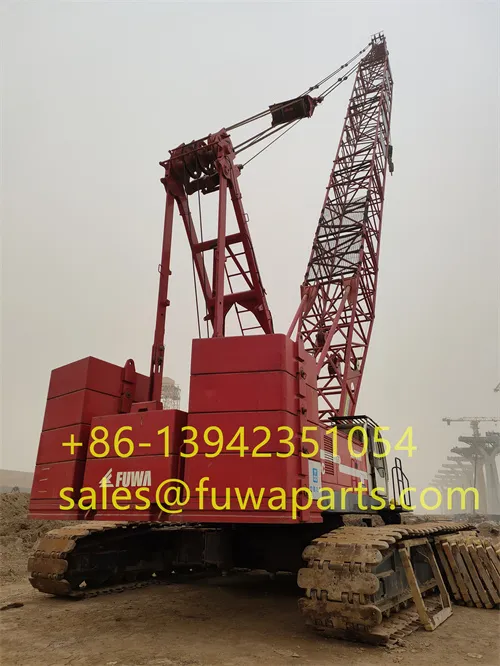
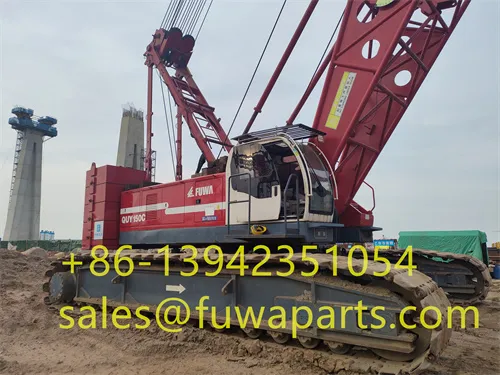
This 2015 FUWA used crawler crane has been sold. It was an 80-tonne class lattice-boom machine configured with an 81 m main boom, a 31 m jib, a Cummins QSL9 engine, Kawasaki hydraulics and a Hirschmann system. We keep these details available so you can compare this machine's configuration with similar units, and if you already run a FUWA crane, you can check the setup before ordering parts. The photographs that came with the sale show the red lattice boom, the tracked undercarriage and the counterweight blocks; paint is weathered and the tracks show the mud and wear of a working machine.
The sale record for this machine shows an 81 m main boom and a 31 m jib. The standard boom set for this model is listed as a 13–58 m main boom and an 18 m fly jib, assembled from a 6.5 m base section, one 3 m insert, one 6 m insert, four 9 m inserts and a 6.5 m tip. Lattice combinations can be built in more than one way, so the section count and pin set on the actual machine should be checked against its delivery documents. Main hoist line parts are listed up to a maximum of 10, and the hook blocks recorded for the unit are 50 t and 8 t. For a crane already in service, we can match crane boom parts by section length, boom foot, boom head or jib insert.
| Max. lifting capacity with 13 m main boom | 80 t |
| Lifting torque | 320 t·m |
| Main boom length | 13–58 m |
| Fly jib length | 18 m |
| Boom combination | 6.5 m base + 3 m × 1 + 6 m × 1 + 9 m × 4 + 6.5 m tip |
| Max. line pull | 8 t / 13 t (4 layer) |
| Max. line speed | 116 / 58 m/min |
| Wire rope length | Main 26 mm / 220 m; auxiliary 26 mm / 180 m |
| Brake type | Wet type |
| Transportation dimensions (L × W × H) | 9,075 × 3,300 × 3,455 mm |
| Swing speed | 3 / 1.8 r/min |
| Travel speed | 1.3 km/h |
| Machine weight | 83 t |
| Counterweight | 24 t |
The Cummins QSL9 engine is rated 209 kW at 2,000 rpm and draws from a 485 L fuel tank. For transport, the main body travels at about 25 t, so the counterweight and boom sections need to be planned as separate loads. Ground pressure is 0.08 MPa on 860 mm crawler shoes, a useful figure when checking prepared platforms and site roads. The engine is a common Cummins platform, and we can match filters, sensors and engine parts through our construction machinery spare parts range. Use the transportation dimensions listed for this machine when checking low-bed trailers, permits and site access.
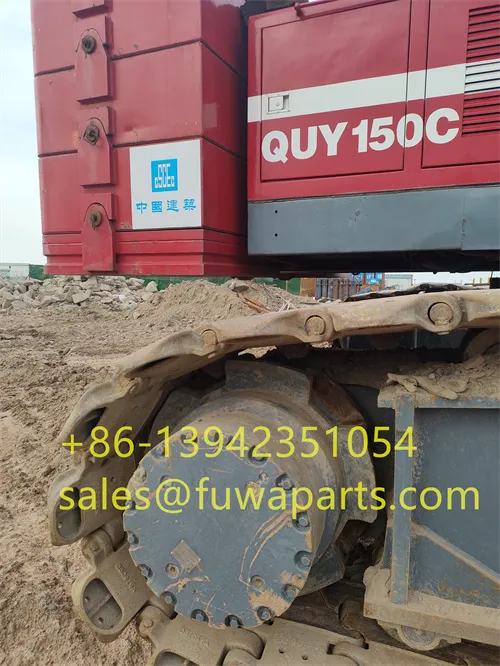
On a used crawler crane of this age, the review starts at the undercarriage: track chain, shoes, rollers, idlers and the final drive hub. Next come the boom sections and pins, the boom hoist ropes, the wire rope on main and auxiliary drums, and the condition of the sheaves. Hydraulic hoses, cylinders and valve blocks should be checked for leaks and previous repairs, and the engine should be run up to temperature before oil pressure and exhaust are judged. Every safety device needs a live test, not just a visual check. The photographs show weathered red paint, mud on the tracks and rust at some edges; those are cosmetic on a working machine, but they are also a reminder to inspect the structure underneath. Ask for the working-hour record, maintenance history and any repair records before committing to a similar unit.
This machine has been sold, so the useful next step depends on what you need. If you are looking for another used crane, send the lifting capacity, boom and jib combination, working hours and destination you have in mind, and we will check what is currently available. If you already run a FUWA crane, we can match parts against the model and part number without waiting for a machine sale. FUWA has built construction equipment since 1904, and we have supplied its crawler cranes and parts for close to ten years, with buyers in more than 20 countries and service stations in many of them. As crane parts suppliers, our engineers can also discuss on-site support where a repair needs it.
| Price at time of sale | USD 90,000 |
| Minimum order quantity | 1 Piece |
| Payment | T/T; Western Union or as agreed |
| Lead time | Most parts in stock. Usually need 7-20 days, according to the quantity. |
| Port of loading | Shanghai, Dalian, etc. |
| Trade terms | EXW, FOB, CFR, CIF |
| Warranty | 2500 Working Hours or One Year |
| Quotation | Itemised, showing condition and price for each line before you approve |
| Part condition | New, used or reconditioned, stated per item |
| Packing | Export cartons and crates, parts braced and protected against moisture |
| Shipping method | Sea, air or courier, matched to the size of the consignment and how soon you need it |
| Export documents | Invoice, packing list and bill of lading; any other paperwork confirmed when the order is placed |
Not sure which part matches your machine? Send us the model, serial number and the original part number — or a photo and key dimensions — and our engineers will confirm the correct item and check availability before you commit. They have spent more than ten years in construction machinery and can talk you through fault-finding, installation and commissioning by phone, email or video. We also trace parts for discontinued and legacy models. Support runs 24/7 from Shenyang, China, where we have been supplying buyers since 2017.
Yes. Send the model, serial number and the number on the old component, or clear photos and key dimensions. We can then check filters, seals, undercarriage items, hydraulic components and electrical parts against the machine records.
Yes. Beyond boom sections and the undercarriage, we supply the engine, hydraulic, hoist, electrical and safety items that keep a crawler crane working. For the Cummins QSL9 used in this class of machine, that includes filters, belts, gasket sets, sensors and the service parts mechanics ask for at each interval, so a routine service does not turn into a hunt across several suppliers. On the hydraulic side we cover pumps, motors, valves, cylinders, hoses and seal kits for the main, auxiliary and boom hoist circuits, which means a leaking cylinder or a tired valve can be quoted with the rest of your list. Hoist and winch wear parts are part of the range as well, including wire ropes, sheaves, rope guides and brake components. Electrical and control items include the sensors, switches, relays and wiring sections used with the Hirschmann system, along with the parts behind the overload alarm, boom back stop and hoist limit devices; these should be replaced with matching items so the safety circuit stays reliable. Cabin and comfort parts such as air conditioner components, glass, wiper assemblies and seats can be sourced too. Send the model and component number for anything you need and we will confirm what is available.
Yes. We source for FUWA, SANY, XCMG and ZOOMLION machines, including discontinued and older models where a part number or drawing can be matched. Send the model and part number and we will confirm what is available.
Yes. A mixed fleet does not have to mean a mixed set of suppliers, because SANY, XCMG, ZOOMLION and FUWA are all handled through the same sourcing route. Send one list covering every machine in the yard and you receive a single quotation instead of chasing each brand separately. Where a component number is worn away or unreadable, photographs of the nameplate, the failed part and a few basic measurements are usually enough for us to compare against the parts books and identify the right item. Grouping lines into one consignment keeps freight and customs paperwork down, which matters when the order covers several small parts rather than one large assembly. If you replace the same items on a regular schedule, keep that list on file with us so repeat orders can be quoted quickly against it. Mark which lines are urgent and which can wait, and give a quantity for each, so one slow item does not hold up the whole delivery. On older machines where a genuine part is no longer produced, ask for the alternatives and we will set out new, used or reconditioned options for you to approve.
The model and serial number, the original part number if it is readable, and a photo of the component in place are the most useful. Key dimensions help when the number has worn off. With those details we can confirm fitment before you commit.
Yes. Boom foot, boom head, 3 m, 6 m and 9 m inserts and jib sections can be matched by section length, pin spacing and connection details. A photo of the end fitting and the stamped section number makes the check faster.
Start with the main, auxiliary and boom hoist circuits: check pumps, motors, valve blocks, cylinders, hoses and seals for leaks, heat and previous repairs. A pressure and function test tells you more than a visual inspection alone.
Check the undercarriage first: track chain, shoes, rollers, idlers and final drive. Then inspect boom sections and pins, wire ropes and sheaves, hydraulic leaks, engine condition and every safety device. Ask for working hours, maintenance records and repair history before you agree a price.


