





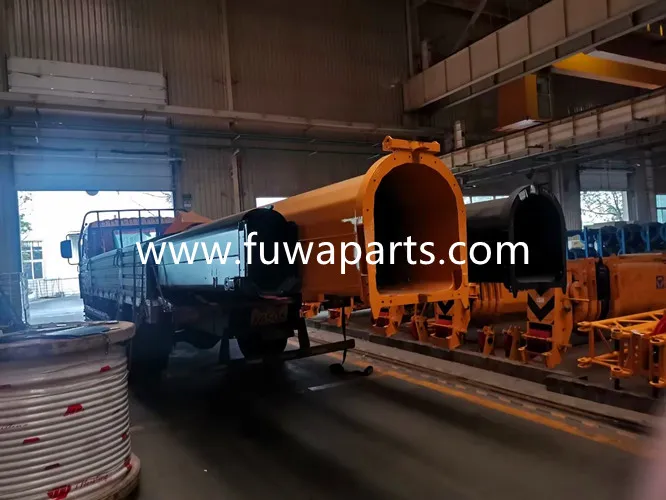
The telescopic boom is the working arm of the 25 t XCMG truck crane, and this is the replacement supplied for machines already in service. Because the boom carries the whole lifting duty of the upperworks, a bent section, a cracked weld or a scored sliding face takes the machine out of production until the right part is on site. Replacement is quoted around the part that has failed, so send the section reference or a clear photograph of the damage and we will confirm whether it is supplied as a section or as a complete assembly.
Most orders come from fleet maintenance teams and repair workshops that already know which section has gone and need it matched exactly, along with contractors who have taken on a machine and are working from photographs. The route is the same either way: confirm the crane from its own plate and serial data, confirm the section, confirm the damage. Crane boom parts are not an area where a near match is good enough.
The boom sits inside a much wider stock that also covers crawler crane parts, undercarriage, hydraulic and electrical components and filters for SANY, ZOOMLION, XCMG and FUWA machines. That is useful when one repair turns into a list — pins, bushings, wire rope and a boom section can be quoted and packed together instead of being chased from three different places.
Rental fleets, workshops and other crane parts suppliers buy from us because the part is checked against the machine before it ships, not after. The section reference, the machine plate and the damage all have to agree before anything is packed.
| Model reference | QY25K-II |
| Machine configuration | telescopic-boom truck crane on its own carrier |
| Units | millimetres for dimensions, kilograms for weight |
| Overall length | 12650 |
| Overall width | 2500 |
| Overall height | 3380 |
| Total weight in travel | 29400 |
| Front axle load | 6200 |
| Rear axle load | 23200 |
| Travel state | boom fully retracted and stowed on the carrier |
| Max. travel speed | 75 km/h under its own power |
| Travel between sites | on its own wheels where local road rules allow |
| Min. turning diameter | 21500 |
| Min. ground clearance | 275 |
| Approach angle | 16° |
| Departure angle | 13° |
| Max. grade ability | 30%, a percentage gradient rather than degrees |
| Fuel consumption for 100 km | ≈37 L |
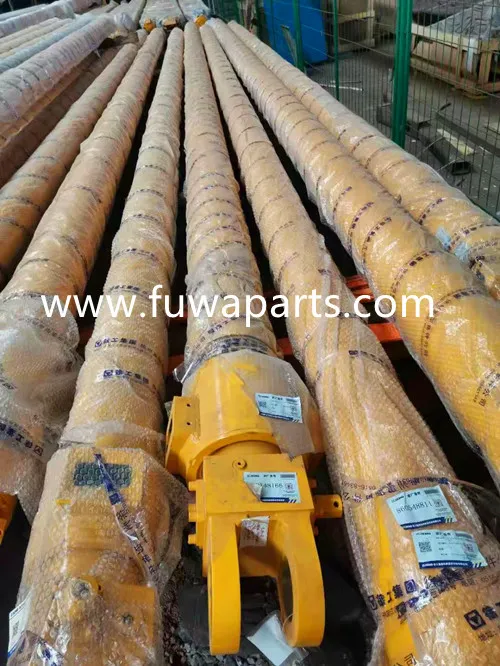
Boom luffing from the transport position to a working angle takes 75 s, and full extension takes 100 s. Max. swing speed is ≥2.5 r/min, and the main and auxiliary winches both run at ≥120 m/min single line. Crews on repetitive lifts feel these figures more than almost anything else on the sheet, and they are the first numbers to slip when crane spare parts in the hydraulic circuit are worn beyond specification.
Those times assume the machine is healthy. A telescoping cylinder that drifts, a winch brake that drags or a swing motor that groans each cost seconds on every cycle, and they are hydraulic crane parts problems long before they become capacity problems.
A yard that has been running a used crawler crane on precast or plant handling and adds a truck crane usually finds the difference in setup rather than in capacity. Luffing and extension times are what decide how quickly the machine is back on the hook after it has been moved, and that is where a well-maintained boom pays for itself.
Not sure which part matches your machine? Send us the model, serial number and the original part number — or a photo and key dimensions — and our engineers will confirm the correct item and check availability before you commit. They have spent more than ten years in construction machinery and can talk you through fault-finding, installation and commissioning by phone, email or video. We also trace parts for discontinued and legacy models. Support runs 24/7 from Shenyang, China, where we have been supplying buyers since 2017.
Yes. Replacement is quoted around the damaged area, so send the section reference or a photograph of the failure and we will confirm whether it is supplied as a section or as a complete assembly. Most crane boom parts enquiries we handle are for one section rather than the full arm, and the packing is arranged accordingly.
Send the machine model, the serial number and the section reference, plus a photograph of the machine plate and of the old part. We match on those, not on a picture alone. If the reference has worn off, dimensions taken from the old section are usually enough to narrow it down before anything is ordered.
Yes. Older machines are where the paperwork is usually thinnest, so we work from drawings, part numbers or clear photographs of the original item. Share the machine model and whatever documentation survives, and the crane spare parts you need are matched or quoted with the options that are still available.
Start with the telescoping cylinder and its hoses, then the winch brake and the swing circuit. These hydraulic crane parts are what turn a healthy boom into a slow one, and they are cheaper to deal with while the boom is already open than after the machine has been reassembled.
Every section is supplied new. Nothing comes from a dismantled machine, and reconditioned heavy equipment spare parts are not sold here as new. Parts are inspected before packing, and the warranty runs from the same terms as the rest of your order: 2500 working hours or one year.
Yes. Send a dimensioned drawing, or measurements and photographs of the old section, and the team will confirm what it has to fit. Construction machinery spare parts for older or discontinued machines are often matched this way, because the original reference is no longer listed anywhere.
Yes, and it is a common request. A used crawler crane or a parked truck crane often arrives without paperwork, so the machine plate, the serial number and a few photographs are what we work from. Inspecting the whole boom first is worth the time, because the failed section is rarely the only one with wear.
Yes. Mixed lists are normal — crawler crane parts, undercarriage, hydraulic and electrical items for other machines can be quoted together with the boom section, so the paperwork and freight are handled as one requirement.


