Product Overview
The clutch and pressure side of an XCMG truck crane is a small system with a large say over the working day. A master cylinder that will not hold pressure keeps the machine in the yard, a 300 bar pressure sensor reading wrong puts a fault on the display the operator cannot clear, and a flasher relay can hold up a road-going carrier at inspection time. This group covers that corner of the machine — a clutch cylinder, three oil-pressure sensors and a flasher relay — for the XCT35, XCT70, XCT90, XCT110 and QY70, drawn from the hydraulic and electrical shelves rather than the structural one. They are mobile crane spare parts that share a single behaviour: every one of them is bought by number.
The cylinder is the hydraulic half of the set. It converts pedal travel into pressure at the slave cylinder so the driver can disengage the clutch and select a gear, and it is what normally gets replaced when a pedal sinks or a gearshift starts crunching. The three sensors are the electrical half — one of them a five-pin pressure sensor — and each reads oil pressure at its mounting point, passing the signal to the controller and the cab display, which is where a technician first notices that a circuit is behaving badly. The relay works on the indicator and hazard circuit instead, and it is the kind of small item that gets added while the machine is already in the workshop, so a second repair does not turn into a second delivery. Taken together, these are the XCMG spare parts that decide whether a carrier leaves the yard on time — small, awkward to work around, and useless to guess at.
These parts are ordered by number, not by description. The number printed on the unit being replaced decides what goes into the box; two of the sensors look almost identical from the outside and are tagged to different machine sets. Our stock is labelled with both the part number and a serial, so the number can be checked at both ends before dispatch. If you buy XCMG crane parts for more than one carrier, say so when you send the list — as crane parts suppliers, we can pack items from different parts of the machine together.
Clutch Master Cylinder
- What it does. The cylinder converts pedal movement into hydraulic pressure at the slave cylinder. Without that pressure the clutch will not release cleanly, and the driver feels it at once as a low pedal and a gearshift that crunches when the machine is hot. Among the crane hydraulic parts on a carrier, it is the one whose decline the operator notices first.
- How it fails. Seals inside the bore wear and fluid begins to pass the piston. Typical signs: the pedal sinks slowly when held down at a standstill, the reservoir level drops with no visible leak on the outside, the pedal returns lazily, or a damp patch appears under the pedal box. A sudden total failure is less common than a slow decline spread over several weeks.
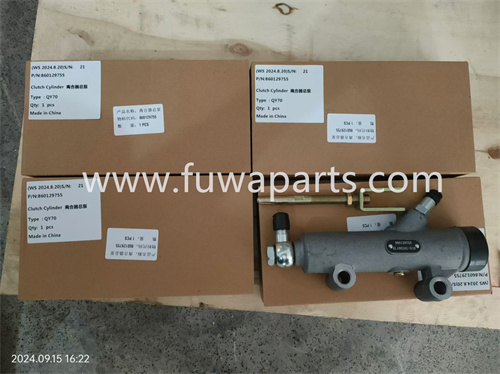
- What arrives in the box. A complete clutch master cylinder with the push rod, the black reservoir cap and the mounting ears already fitted, boxed on its own with a printed label carrying the part number and a serial. Check that label against your own record before the old unit goes in the scrap bin.
- Compare before you fit. Put the new unit beside the old one and compare push rod length, outlet angle and the position of the mounting ears. A cylinder that bolts to the pedal box but carries a different rod length will not release the clutch through the full pedal stroke, and that difference is far easier to see on the bench than after the line is full of fluid.
- Check the rest of the circuit first. A soft pedal is not always the master cylinder. Look at the slave cylinder for weeping, follow the hydraulic line for a chafed or damp section, and check the pedal bushes for play before ordering. Replacing a healthy cylinder will not cure a leak downstream, and the new part usually gets blamed for it.
- Fluid and cleanliness. Use the fluid grade the machine's own manual specifies, flush the line rather than topping up dirty fluid, and leave the reservoir cap on while you work. Grit is what finishes most replacement cylinders early, and no part is built to survive it.
Pressure Sensor Identification
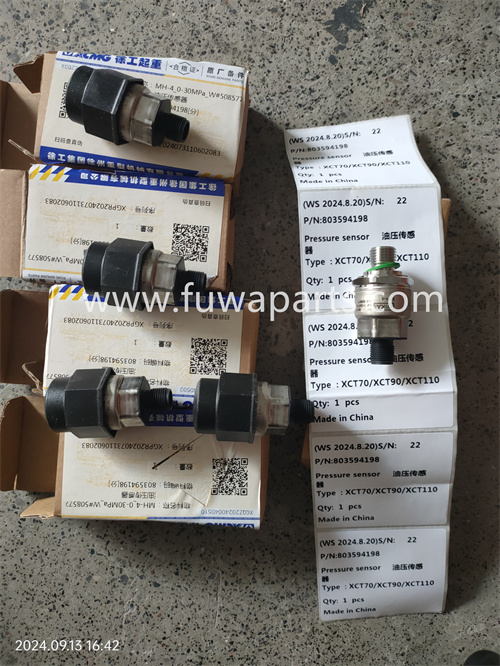
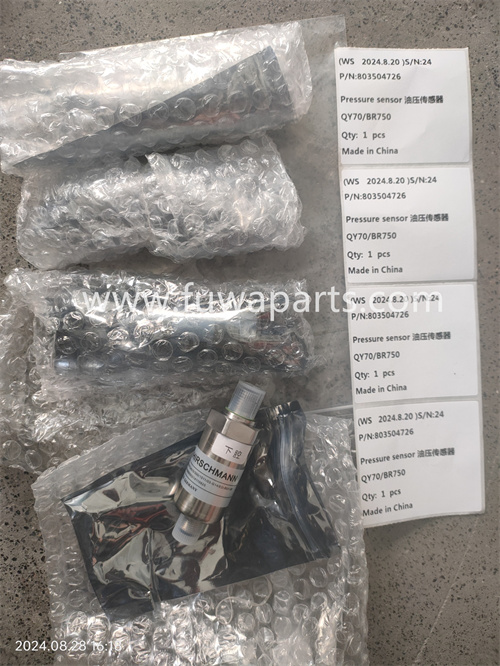
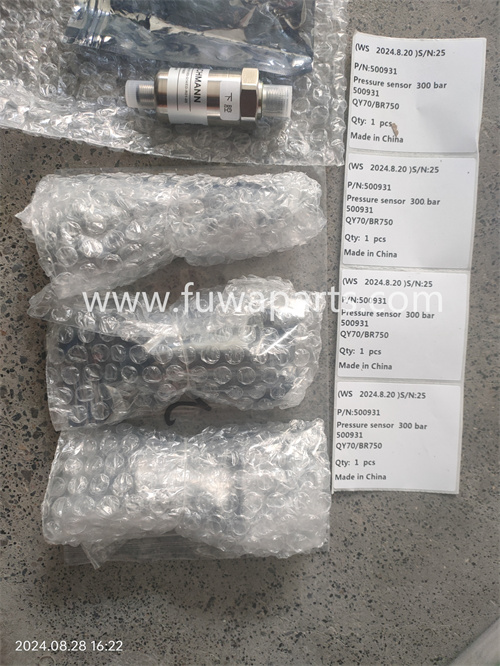
- Start with the number on the old sensor, not the model name. Three XCMG pressure sensor numbers are listed here: 803594198, 803504726, and a third listed as 1511 and marked five pins, 300 bar, carrying the number 500931. That label is the only reliable starting point once a machine has been through a few repair cycles.
- Read the model tag on the label. The tag on 803594198 names XCT70, XCT90 and XCT110; the tag on 803504726 names QY70 and BR750. Where the number matches but your model is not on the tag, send the machine details anyway — XCMG crane parts are shared across more carriers than any one label lists, and the reference files crane parts suppliers keep will often show the crossover.
- Confirm the connection and the rating. The third sensor is a five-pin pressure sensor rated at 300 bar, roughly 30 MPa. Pin count and pressure rating both have to suit the circuit: a sensor with the right thread and the wrong rating will screw in perfectly and still report the wrong pressure.
- Compare the body. These are cylindrical sensors with a hex nut for the spanner and a threaded metal end, and one of them carries a green band around the body. In a store where several sensors sit in the same drawer, the band and the label are what stop the wrong unit being picked.
- Look at how it seals. The thread holds the sensor in place, but the seal is made at the face or on a washer. Check the old unit for a crushed or missing sealing ring and fit a new one rather than reusing it.
- Test the circuit before you condemn the part — sensors are crane electrical parts, and a reading out of range can come from corroded connector pins or genuinely low circuit pressure as easily as from a failed sensor. Work the plug on and off and look at the pins first.
- Photograph the mounting point before dismantling anything. One picture of the label, one of the connector and one of the surrounding pipework answers most fitment questions in a single message, and the machine can go back together while the replacement is in transit.
Flasher Relay
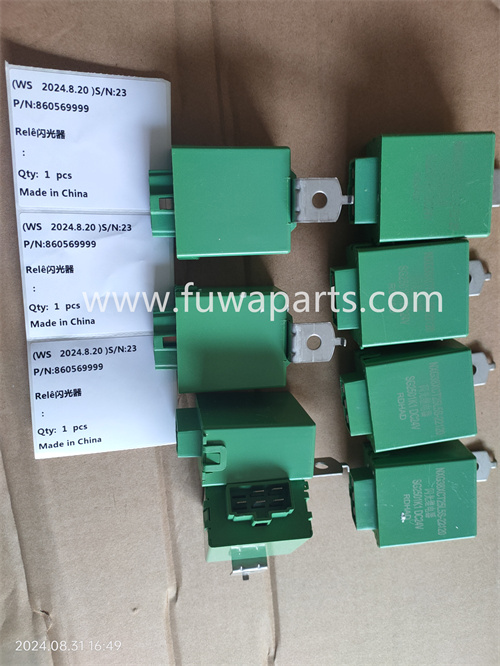
The flasher relay is the smallest item in the group and the one most likely to hold up a road-going carrier at inspection. It is a green moulded module with a metal mounting tab and a plug-in connector socket, and our stock label reads "Relé flasher", which is how the same item appears in Portuguese catalogues. It belongs with the crane electrical parts rather than the hydraulics, driving the indicator and hazard circuit at a steady flash rate.
When it fails, the indicators may light and stay lit, flash at double speed, or go dead on one side while the hazards still work. Before condemning the relay, check the bulbs, the fuse, the earth points and the indicator switch — a single blown bulb changes the flash rate on most systems and costs far less to put right. Relays are also among the few construction machinery spare parts a workshop can change in a few minutes, which is why a spare on the shelf is worth having.
Pin layout decides whether a replacement actually works. Two relays can share the same housing shape and mounting tab and still be wired differently inside, so one that plugs in is not automatically correct. Order against the printed number 860569999 and, where the label has worn away, send a photo of the old relay and its socket instead. That one check is the difference between a quick fix and a second delivery.
Specifications
| Category | Mobile crane spare parts — crane hydraulic parts (clutch actuation), oil-pressure sensing and indicator circuit |
| Clutch master cylinder | 860129755 |
| Clutch cylinder fits | XCMG XCT35, XCT70, XCT90, XCT110, QY70 |
| XCMG pressure sensor | 803594198 — XCT70, XCT90, XCT110 |
| Pressure sensor | 803504726 — QY70, BR750 |
| Pressure sensor | 500931 — listed as 1511; 300 bar pressure sensor, five pins (about 30 MPa) |
| Flasher relay | 860569999 — "Relé flasher" |
| Sensor body | Cylindrical, hex nut, threaded metal end, sealed at face or washer |
| Relay body | Green moulded housing, metal mounting tab, plug-in connector socket |
| Labelling | Part number and serial printed on every item |
| Order reference | The number printed on the unit being replaced |
Model Coverage and Fitment Checks
- XCT35, XCT70, XCT90, XCT110. The clutch cylinder and the flasher relay are listed for this carrier group, and two of the three XCMG pressure sensor part numbers are tagged to the XCT70, XCT90 and XCT110. Coverage runs by number, so an earlier or later build of the same model normally takes the same part.
- QY70. The clutch cylinder carries a QY70 tag, and the 803504726 sensor is tagged QY70 and BR750. If your yard runs both QY and XCT carriers, keep those sensor numbers apart in the store — this is the pair most often mixed up.
- Older machines. Numbers get superseded and printed labels fade. Most XCMG spare parts for these carriers can still be traced by number long after the model has left production, so send the number off the old unit rather than working from the model year.
- What to send when you are unsure. A photo of the label on the old part, a photo of the machine plate, and the number you read from it. For the five-pin pressure sensor, a shot of the connector also helps. With those three the answer is usually immediate; without them, buying XCMG crane parts becomes guesswork with a freight bill attached.
- Checked before it ships. The number you give us is matched against the reference on our stock label before packing. Where the two do not agree, we come back to you rather than send something that will only come back.
- Consolidating a repair. A clutch job and a sensor fault on the same carrier tend to turn up in the same week. Hydraulic, electrical and cab items are held together in Shenyang, so the parts for one repair, plus construction machinery spare parts for other machines on site, can leave as a single shipment.
- Beyond this group. What is listed here is a small slice of the range: mobile crane spare parts for crawler, truck and all-terrain carriers, covering machines from the QUY50 up through XGC650, QY25K and XCA220, plus XR-series rotary drilling rigs. If your number is not shown, it is still worth asking.
- Comparing suppliers. Ask any crane parts suppliers you deal with to confirm the number against the machine before dispatch. It is the cheapest check in the process and the one that decides whether a repair runs on schedule.
Installation and Commissioning
- Park on level ground, chock the wheels and let the machine cool. Clean around the clutch cylinder, the sensor ports and the relay socket before opening anything — dust pushed into a hydraulic port or a connector is the most common reason new crane spare parts underperform.
- Remove the old clutch master cylinder. Disconnect the push rod from the pedal, cap or plug the hydraulic line to stop fluid running, and note the outlet angle and rod length so the replacement goes back the same way.
- Fit the new cylinder and bleed at the slave cylinder, not at the master. Keep the reservoir topped up through the bleed so no air is drawn back in, and continue until the pedal is firm and returns fully on its own.
- Screw the sensor in by hand first, then tighten on the hex with a spanner. Do not pull or twist it by the body or the connector, and use the sealing ring the manual calls for rather than a reused one.
- Tighten to the figure in the machine's workshop manual rather than to feel. Over-torquing crushes the sealing face and distorts the sensor body; under-torquing lets oil weep onto a hot surface.
- With the ignition off, pull the old relay and push the new one fully home. Switch on and test indicators and hazards separately, because a relay can work on one circuit and not the other.
- Run the machine through a full heat cycle, then check for weeping at the cylinder outlet and around the sensor thread. Re-check the fluid level and note the pressure reading on the display so the next technician has a baseline.
Ordering and Delivery
| Payment | T/T; Western Union or as agreed |
| Minimum order | 1 piece |
| Lead time | Most parts in stock. Usually need 7-20 days, according to the quantity |
| Trade terms | EXW, FOB, CFR, CIF; shipped via Shanghai, Dalian, etc. |
| Warranty | 2500 Working Hours or One Year |
| Packing | Small parts in cartons, heavier components in wooden cases, packed for sea, air or rail freight |
Technical Support & Model Matching
Not sure which part fits your machine? Send the part number, the machine model, and a photo of the nameplate or the worn item, and our engineers — each with more than ten years in the construction machinery business — will confirm the correct reference and quote it. We advise on installation, help trace faults, and answer technical questions before and after dispatch. Since 2017 we have built this support on a supplier network covering FUWA, SANY, XCMG and ZOOMLION, so older and hard-to-find references can usually still be sourced.
FAQ
Q1. Which XCMG models do these parts fit?
The group covers the XCT35, XCT70, XCT90, XCT110 and QY70 carriers. Within that, fitment is settled by the number rather than by the model name: two of the three oil-pressure sensors are tagged to different model sets, and the cylinder is listed for the XCT carriers and the QY70. Send the number from the old unit together with the model it came off, and we will confirm which of the XCMG spare parts here is the one you need.
Q2. What core parts do you supply?
Four families. Crane hydraulic parts cover pumps, valves and cylinders. Undercarriage covers track shoes, rollers and sprockets. Crane electrical parts and safety systems cover sensors, controllers and monitors. Boom and attachment parts cover boom sections, jib inserts and hook blocks. The range runs across XCMG, SANY, ZOOMLION and FUWA construction machinery spare parts, and this group sits where the hydraulic and electrical lines meet.
Q3. Do you accept customization for boom and attachment parts?
Yes. Boom and attachment parts can be built to suit different XCMG crane and rotary drilling rig models, including lattice boom sections, jib inserts and hook blocks. The five items in this group are supplied to their printed numbers instead, so a variant usually means a different reference among the crane spare parts we hold rather than a made-to-order part. Send the number you have and we will check it.
Q4. Do you provide technical support for overseas customers?
Yes. Fitment questions, bleeding sequences, sensor pin checks and relay socket checks are handled by the same team that packs the order, in English, by email or messaging, and we are used to working across time zones. If the fault is not what it first looked like, say so before ordering — ruling out a wiring or fluid problem is quicker than returning a part that was never at fault.
Q5. What does "five pins, 300 bar" tell me about the sensor?
Pin count describes the electrical connection, and 300 bar is the pressure it is built to read — about 30 MPa. Both have to suit the circuit it goes into. A 300 bar pressure sensor with the right thread and the wrong rating will mount correctly and still report incorrectly, which then shows up as a fault that moves around rather than clears. Match the number and the label tag first, then confirm the pins and the rating.
Q6. Does the clutch cylinder arrive with its push rod and cap?
Yes. It comes as a complete unit with the push rod, the black reservoir cap and the mounting ears fitted, boxed on its own with a printed label carrying the part number and a serial. Nothing else has to be ordered separately to bolt it to the pedal box and connect the hydraulic line.