





|
|||||||||||
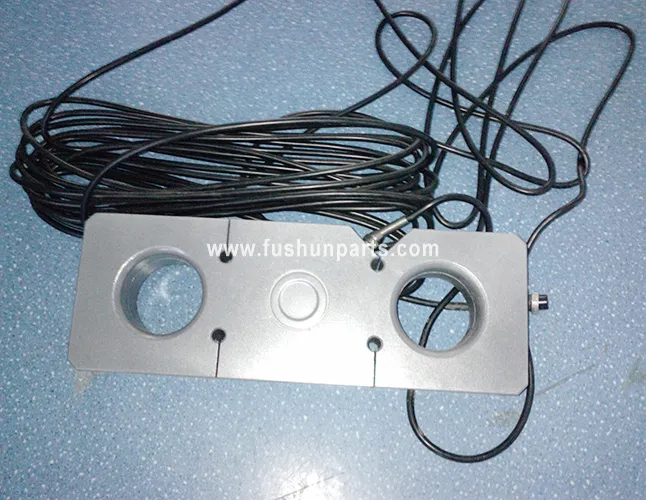
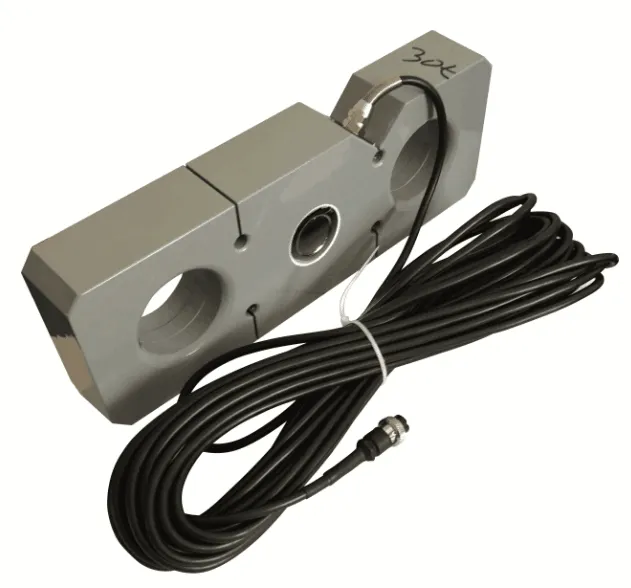
This is a rope weighing load cell — also sold as a crane scale load cell or force sensor — supplied with its cable for cranes that weigh the load at the rope rather than at the boom. Fitted at the weighing point in the rope run, it turns the force in the rope into an electrical signal that travels back to the indicator or load moment limiter in the cab, so the operator works from the load the machine is actually carrying and the limiter can act on that figure.
Inside, the sensing element uses MEMS and Hall technology, and the amplifier is built into the body instead of being mounted separately on the machine. That is what keeps output accuracy steady across the working range, and it removes a junction box and a second enclosure from the installation.
The body is a flat metal plate with a defined mounting face, a small recessed disc at the centre and a side terminal where the black cable leaves the unit. Two large apertures in the plate take the fixings, and the cable is routed through the body so it stays clear of the rope run.
Because the sensor has to agree with the display reading it, this load cell is supplied in more than one output version and is confirmed against your machine before it ships. Tell us the crane model and the indicator it feeds and we will say which version to order — or what to change if the original number is no longer made.
The same body is listed among our crawler crane parts and supplied for mobile cranes that weigh load at the rope, so a fleet running both types can keep one replacement ready.
On a heavy equipment parts list this is a small line, but it is the input the whole load monitoring chain depends on: a sensor that is mismatched, mis-mounted or drifting makes every reading on the display wrong with it.
Within our crane parts supplier range, this sensor sits alongside the monitors, controllers, limiters, displays and cables that make up a complete load monitoring system, so the sensor and everything it connects to can come from one place.
| Parameter | Specification |
|---|---|
| Protection level | IP67 |
| Current consumption | <50 mA (including amplifier) |
| Output signal | 4…20 mA / CANopen / CANopen Safety / 2.5…7.5 V DC |
| Safety overload | 150% (200%) of nominal load |
| Measuring body plastic change point | 200% (300%) of nominal load |
| Fracture point | 300% (500%) of nominal load |
| Temperature drift | 0.1%/10K |
| Linear error | <0.3% FS / <0.5–1% FS / <0.3% FS |
| Lag error | <0.5% FS / <1% FS / <0.5% FS |
| Connector | M12 or CANNON |
| Material | Stainless steel |
| Climate test | EN60068-2-30, DB 55 °C/100% |
| Shockproof | EN60068-2-6, 5–500 Hz, 50 g, 10 min |

| Minimum order | 1 unit, for standard electrical parts and customized systems |
| Condition | 100% new, factory tested |
| Packaging | Secure plywood crates |
| Ports of loading | Shanghai, Dalian and other Chinese ports |
| Trade terms | EXW, FOB, CFR, CIF |
| Payment | T/T, Western Union, or as agreed |
| Standard shipping | 7–15 days by international courier |
| Express shipping | 3–5 days (additional cost applies) |
| Custom orders | Production and shipping within 3–4 weeks after design confirmation |
| Warranty | 12 months on electrical components, covering manufacturing defects |
| Warranty exclusions | Improper installation, unauthorized modification, and damage from extreme environments |
Support does not stop when the sensor ships. If the display reads oddly after fitting, our engineers will work through it with you — on-site help with installation, calibration and troubleshooting where that makes sense, or remote diagnostics if you would rather send error codes and readings by email or WhatsApp and do the work yourself. If any of the crane parts we supplied fails within the warranty period, return it for assessment and we will repair or replace it; repair turnaround is generally 5–10 business days once the part reaches us.
We supply heavy equipment parts for machines that stay in service for decades, which means the useful question is rarely only the part number — it is what will actually fit and keep working on this machine.
As a crane parts supplier, we would rather tell you that a number is unavailable than ship something that will not fit, and we will always explain the route we recommend and why: a like-for-like unit, a different connector, or a sensor and display change together.
When a machine is out of production but still working, the part number matters more than ever. If the number you have is discontinued or hard to trace, send us the machine model together with that number: we search our supplier network, confirm what is genuinely available, and give you a straight answer before you commit. Where the original is no longer made, we set out the alternatives we can actually supply, or an upgrade path, and coordinate samples, inspection and made-to-order work with the suppliers we buy from. Sourcing, consolidation and export handling stay with us.
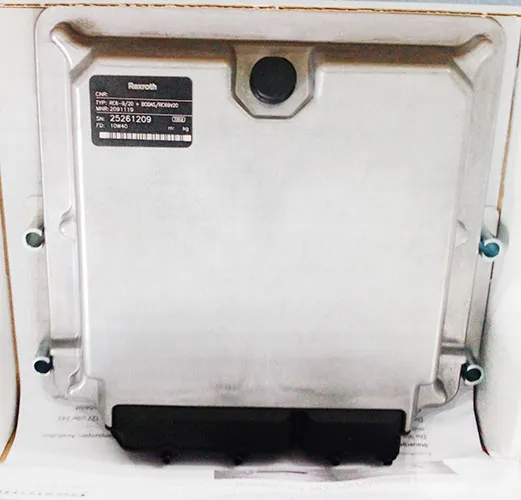

A load moment indicator, or limiter, is the complete system in the cab: it takes the signal, compares it against the machine's rated capacity and warns or stops the motion as the load approaches the limit. This sensor is one of the crane parts that feeds it. You replace the load cell when the weighing channel itself is faulty, and you replace the indicator when the display, the calculation or the alarm is faulty. If you are not sure which end has failed, describe what the display is doing and we will help you narrow it down.
Look at the rope run and the tension device. A machine with a rope weighing system has a sensor body sitting in the load path with a cable running back to the cab, and its display shows a live load figure rather than only boom angle or radius. If there is no sensor on the rope, the machine is measuring load indirectly and there is nothing to replace. Send photos of the winch area and the display if you cannot tell from the outside — we match construction machinery spare parts like this against the machine every day, and a photo is usually enough.
Match the sensor to the indicator rather than the other way round. Send the marking from the display or limiter and the connector on the old sensor and we will confirm which version the machine expects. If the display has been changed at some point, say so — the sensor and the display have to agree, and a mismatch is the usual reason a new sensor reads oddly.
Both are quoted against full scale, so a figure of 0.3% FS means the reading can deviate by up to 0.3% of the sensor's full-scale range. Linear error describes how far the output departs from a straight line across the range; lag error, sometimes called hysteresis, describes how far the reading fails to return to the same point when the load is removed and applied again. The specification table lists a value for each output version, so the figure that applies to you is the one against the version your machine is fitted with.
Fit it the way the original was fitted. On crawler crane parts the sensor sits in a fixed load path, with a defined mounting face and a cable exit, and turning or shimming it to clear an obstruction usually changes the reading. Send a photo of the old unit in position and we will confirm the orientation before you order.
Check the mechanical side first: fixings at the correct torque, the body sitting flat against its face, and the cable routed away from high-current cables and hot surfaces. A reading that drifts with temperature usually supports a cable or connection rather than to the crane spare parts themselves, and a reading that jumps usually supports a loose connector. If those checks come back clean, send us the display behaviour and we will take it from there.


