


A luffing tower fix jib boom works harder than a plain lattice boom. The jib is luffed up and down under load, the sections are erected and struck every time the crane moves, and the same pin joints take reversing stress year after year. The crane boom parts here are built for that duty: a base boom, lettered insert sections, a mid-point boom, a tapered section and two jib tips that pin together into the tower-luffing arrangement used on FUWA crawler cranes.
Every section follows the FUWA boom pattern rather than being a one-off fabrication, which is what makes a repair practical years later. Because these are standard construction machinery spare parts, a bent or cracked section can be replaced on its own and will still pin up to the sections that remain on the crane. The family covers heavy-duty, light-duty and long-boom working arrangements plus the insert tower jib, so one base boom can be rebuilt into a different combination when the next contract asks for it.
We work as hydraulic crane parts suppliers for fleets, workshops and rental yards, so the questions we answer every day are practical ones: which letter belongs at which joint, whether the foot casting matches the machine, and what hardware arrives with the kit. Send the crane model, serial number and the section you are replacing, and we will confirm it against the boom configuration before anything leaves the warehouse.


| Component | Section type | Where it is combined |
| Base | Base boom | Combined use of all configuration. |
| A | Insert boom | Combined use between heavy-duty boom and light-duty boom. |
| B&C | Insert boom | Combined use between heavy-duty boom and light-duty boom. |
| T | Insert tapered boom | Combined use between light-duty boom and long boom. |
| Tip (Li) | Boom tip | Combined use between light-duty boom. |
| D | Mid-point boom | Combined use between long boom and insert tower jib. |
| E | Insert boom | Combined use between long boom and insert tower jib. |
| F | Insert boom | Combined use between long boom and insert tower jib. |
| G | Insert boom | Combined use between long boom and insert tower jib. |
| Tip (Lg) | Boom tip | Combined use between long boom and tower jib. |
Sections are cut from 35SiMn, 35SiMnMo and 28CrMnMo alloy steel, the grades specified for this boom family, and the boom foot is cast steel rather than a fabrication. These are the crawler crane parts that carry the whole jib, so the chords, lacings and pin bosses are welded and machined as a single assembly, with the boss faces finished square to the pin axis so a joint closes without load sitting on the bolts.
Heat treatment follows the original specification, which is what keeps a pin hole round after a season of re-pinning instead of going oval and letting the joint work. Fitting a replacement is one of the more demanding construction machinery spare parts jobs on a crane, because the new section has to line up with sections that are already in service — which is why geometry, not just steel grade, decides whether the repair holds.
Hydraulic crane parts usually announce themselves through pressure loss, heat or contamination. A lattice boom gives different warnings: a bowed chord, a cracked lacing, a pin hole that has opened up, paint cracking around a weld. Read those early and a section swap stays a planned job; ignore them and the boom starts moving under load in ways the lift plan never allowed for.
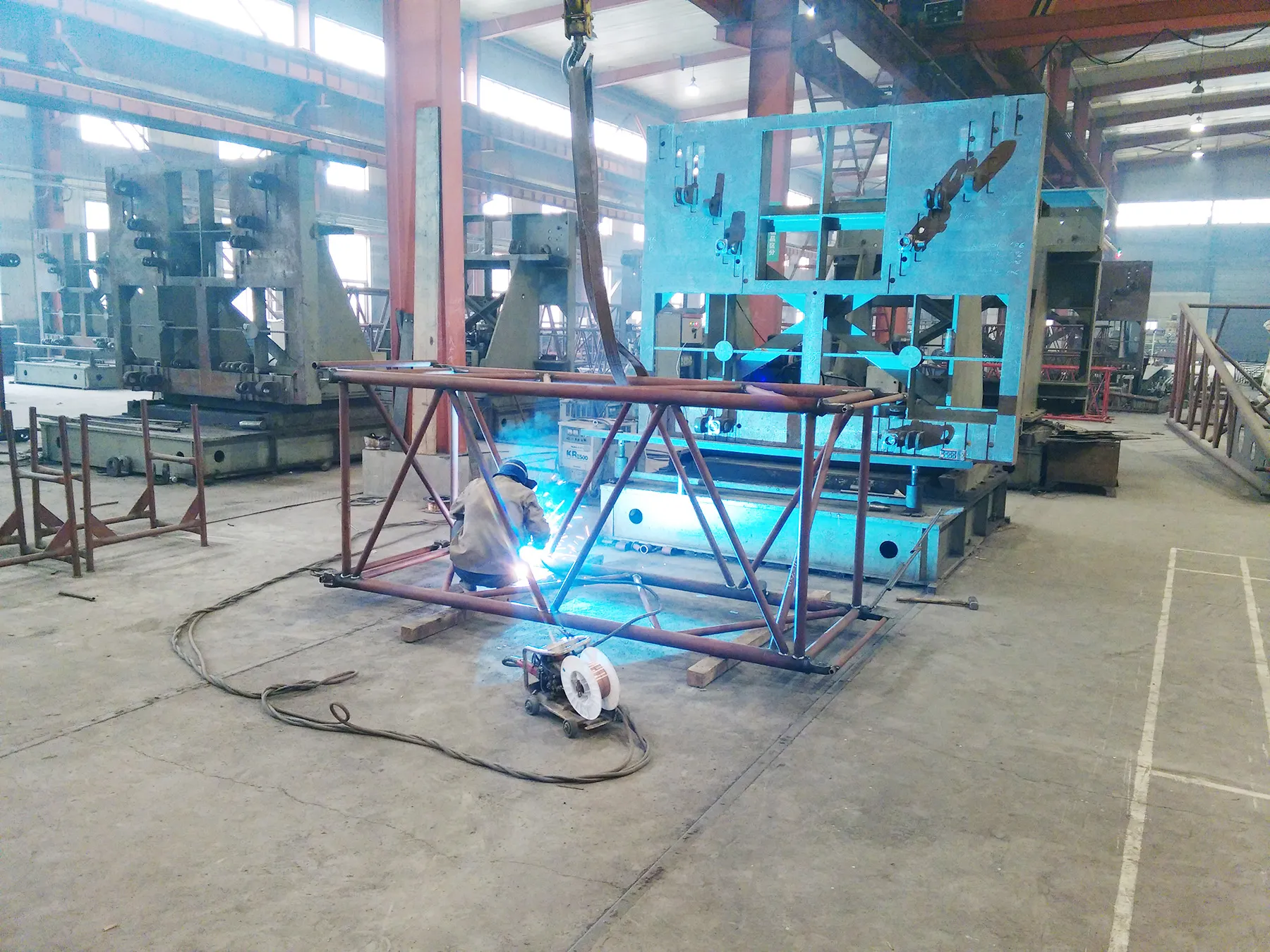
The section on your crane is the primary reference you have. Photograph the joint, measure between pin centres and note any number stamped on the chord; those three details usually settle which section you need without waiting for a drawing. On heavy equipment spare parts of this size a wrong guess is expensive both ways — a section that will not pin up, or a lift plan built around the wrong duty class.
Say so if the boom has been re-pinned, reamed or repaired on site. A section matched to the original drawing will not fit a joint that has been opened out, and the crawler crane parts that left the factory in one arrangement may have been re-configured since. We would rather adjust the section to your joint than have you adjust the joint to the section.
Older machines are routine work. A used crawler crane often carries sections that dropped off the parts list years ago, and when nothing in the range matches we work from your drawing or from the original measured on site. Sections can be made to a drawing you supply, including the pin bosses and the hardware set, and checked against your boom before dispatch.
Not sure which part matches your machine? Send us the model, serial number and the original part number — or a photo and key dimensions — and our engineers will confirm the correct item and check availability before you commit. They have spent more than ten years in construction machinery and can talk you through fault-finding, installation and commissioning by phone, email or video. We also trace parts for discontinued and legacy models. Support runs 24/7 from Shenyang, China, where we have been supplying buyers since 2017.
Yes. Older machines are a large part of what we handle — a used crawler crane is often still working long after its section list has gone quiet. Send the machinery model, any number stamped on the section, or a drawing, and we will match an existing section from the range or make one to your drawing.
Send the crane brand, model and serial number, plus a photo of the joint and of any stamping on the chord. We compare those with the parts list for your machine and confirm the section, its position in the configuration and the hardware that comes with it before you commit. That check is what we do as crane parts suppliers, and it is quicker than correcting a wrong section on site.
Yes. Sections are supplied individually, so a bent 6 m insert or a worn boom foot can be replaced on its own. The crane boom parts that stay on the machine keep their own pin joints, which is why we check joint condition with you before the section is prepared for dispatch.
New. Sections, kits and hardware are supplied in new condition — no reconditioned or used components go into an order. It matters most at the pin joints, where a re-used boss or a straightened chord can look acceptable and still move under load. Every crane spare parts line we send out is checked against the order before packing.
The sections shown in our photographs carry a red painted finish. If your fleet works coastal, offshore or at a mine, tell your sales contact which coating the site expects and we will confirm what can be supplied with your order — coating is worth settling before the sections are packed, not after they arrive.


